Showing posts with label Church. Show all posts

Wednesday, January 20, 2010

Peeling Onions

PART I

Dunstan St. Omar, a celebrated local Saint Lucia artist, said it the best: “The curse of the Caribbean is that our poverty is picturesque”. This island is not the most poverty-stricken nation in the world, but poverty exists here.

Before I was invited to Saint Lucia, my impression of the Caribbean islands was created from the Sandal’s commercials shown on television.

People who visit the island and stay in an all-inclusive hotel or get off a ship for an afternoon are whisked away in an air-conditioned taxi to see the island: the beautiful Pitons, Sulphur Springs, the crystal clear aqua Caribbean, the incredible interior with dense rain forest.


There is a dense population of taxi drivers and competition is stiff. When he is alone, he drives with the windows down and the air-conditioning off to save a few pennies in gas money. Few tourists have time to see beyond the beauty and most aren’t looking for it.


As a volunteer, these are the things I first saw when the plane landed and I boarded a clean air-conditioned bus for the hour and a half trip across the island.


I saw vendors roasting corn by the roadside and selling local fruits which they farm. I saw my first sight of Castries. I stayed in a retreat for a few days and was well fed. I sat in air-conditioned rooms while being oriented to the island.


After a few days, training begins. I was invited to live in the home of a middle-class family who struggles to make a living. They have cable TV, electricity and running water – although the water was not hot. There was no internet.


Although they have three children at home who attend school and one in college, internet is a luxury they cannot afford. I used public transportation and was given just a couple of dollars a day for “walking around” money. Although many people stared at me, ask me for money or think I am a tourist in need of a taxi, at times I began to feel Saint Lucian.


It didn’t take more than a few weeks before I saw things that many Americans might describe as hardship; the lack of electricity in some homes and public wash facilities in the villages where I live. Of course there is no air conditioning, but I never expected that anyway.


The layers of the onion are peeled away as I mark my calendar with what little time I have on the island. It takes awhile longer before I began to see the depth of Saint Lucia poverty; the families that live off the beaten path on dirt roads in sheds or the families who are camping behind the trees in the bay by the sea, the children who don’t go to school because they don’t have the money to buy school uniforms; the illiteracy and sometimes hopelessness that abounds. And, then there are the children who don’t have enough to eat.


Then things happen that make me wonder, “Do I really understand the depth of poverty?” Or, are there more layers? I hope I don’t experience anything more that gives me content for the subject of this post. I want this to be my last post on this subject.


PART II
******************

It is Wednesday morning. I walk down the road towards the primary school. I pass the secondary school and notice the principal, usually dressed in business casual is wearing a suit. I walk up to the classroom where I teach primary school Junior Achievement and the teacher confirms what I already know, “yes, we are closing school today at noon." We will do the Junior Achievement lesson next Wednesday. I remember I need a few things from the store and I need to get them now as it appears the entire village will shut down at noon.


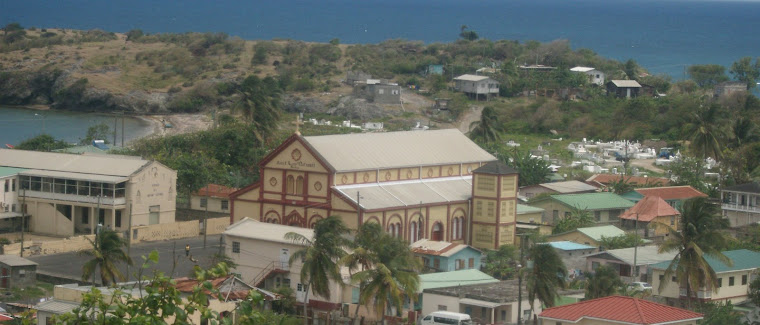
I pick up a few staples at the market and bread at the bakery. I walk up the stairs to my apartment and look out the window at the parking lot of the Catholic Church. There are children playing games with their teacher. They are laughing and having a good time.


It is 1:00 now. Secondary school children are still in uniform walking down my street towards the church. In a few minutes, a hearse will drive through the village with a procession of mourners walking behind it. At 2:00 the mood at the church will be somber. The church will be overflowing into the parking lot. I will hear gospel singing. Cars will line the nearby streets.


PART III
******************


The only hospital on this side of the island was destroyed in a fire three months ago. I now understand the devastating impact it is having on people. A make-shift hospital in an athletic stadium, with little equipment and doctor’s on-call, is the only choice on this end of the island. The girl, who was stabbed, died in that make-shift stadium hospital.


There is one ambulance here and when it’s down for maintenance, people must wait. The ambulance carrying the girl had to drive slowly to the stadium because the tires were bald. It took time to bring a doctor to the facility.

It makes me wonder who is at fault:
  • Is it the culture of reaction to infidelity?
  • Is it the ambulance driver who refused to drive faster?
  • The ambulance company who allowed the vehicle to use every thread of tread before replacing worn tires?
  • The government for not ensuring the hospital is re-built?
  • Was it the girl who stabbed her?
  • Was it her friend who gave her the knife?
  • Or, could it be the doctors who didn’t get there in time?


PART IV
******************


The other end of the island is met with another story. A friend of mine has a little boy who was hit by a truck shortly after Christmas. In critical condition, he was rushed to the public hospital. When his father realized that the scissors the nurse was using weren’t sharp enough to cut off his boy’s shirt he was horrified. The hospital did not have the resources to buy a pair of scissors.


The boy was fortunate because his father has insurance and he was immediately transferred to the only other hospital on the island; a private facility and nearby. The portion of the bill that will not be covered by insurance will undoubtedly leave the family in debt; but medical debt is an American story too. Happily, the boy is doing fine and will recover.
More layers of the onion are peeled away.


PART V
******************


I have a mantra about money that I have carried with me for thirty years: Money is only important when you don’t have it. Right now money is important to that little boy and his family. Money may have made a difference in the little girl's destiny. This makes me angry. It makes me sad. It makes me ask questions for which I previously didn’t know I needed an answer.


Is it just an entire system of broken processes and infrastructure? Or, was Dunstan Omar right when he said, “The curse of the Caribbean is that our poverty is picturesque”?

(If you stayed with me during this long and drawn out angry post, I promise something more uplifting next! Thanks for listening.)

Wednesday, January 21, 2009

Making Friends

As I enter the church I hear a man praying. He is in the front of the room with a microphone in hand. The steam from his emotions is flowing into every corner of the church. People have their hands outstretched, palms facing the sky, eyes closed. They are swaying back and forth.


It’s a small church with about 70 folding chairs and I start to follow a group of parishioners to the back of the church when Bertha takes my arm and leads me to three folding chairs in the front row; one for her, one for her husband and I am seating between them.


To date, I’ve only attended the Seventh Day Adventist service. I suspect this will be different when I see drums, an electric guitar, an electronic keyboard, sound equipment and three standing microphones behind a pulpit with plastic flowers in front of it.


A few nights before, I attended a meeting at Monroe College in Castries for faculty and then a follow-on meeting for new students. They served a nice dinner under in the large tent just outside the college. I took my food and sat on one of the picnic benches and talked with a few faculty members and a few of the new students. They were understandably anxious about their decision to return to college; math and statistics were high on their list of fears. I could understand every syllable of their fear; it’s been only a few years since I was one of them. I tried to assure them they could do it; that it would be hard but not impossible.


It was near 8:00 that night when I grabbed my red backpack and headed down the stairs behind the Saint Lucia Bank and toward the quietness of Castries Marketplace. During the daylight hours, Castries is a bustling city with vendors, shoppers, bars, music and restaurants. When there are ships in the harbor the Marketplace is filled with tourists wearing shorts and t-shirts. They are carrying large camera’s, backpacks and satchels filled with a few fruits and mementos they will bring back signifying the few hours they spent on the island.


By this time of night everyone has gone home and there is a stillness and peace about the city. The only activity seems to be waiting bus drivers and passengers as well as the inevitable taxi driver who whispers “Taxi?” as I take a short cut through the park. Busses don’t leave Castries until they are filled to capacity. There is no schedule. On this night I was the last to arrive and there was only one seat in the front. As I got into the bus, I said, “Good night everyone, I bet you are all happy to see me. Now we can be on our way!”


The woman sitting next to me said, “Did you enjoy the meeting and dinner?” I didn’t recognize her until she reminded me she is a Monroe College Professor. As we talked I learned she lives in my village, her husband, Melvin, is a taxi driver/tour guide, and he is also the preacher at the Pentecostal Church in Laborie. Melvin met us at the bus stop in his taxi. They offered me a ride to my house and invited me to their church service. I felt like I’d known Bertha and Melvin my entire life. That’s how I landed at church this morning.


Bertha leaned over looking at the man leading prayer and whispered in my ear, “He’s blind you know”. I could hear increasing volume and emotion with every hallelujah, thank you Jesus, praise the load, amen and praise God. Then everything was silent. A young woman walked up the stairs and took his hand a led him back to his seat.


A young woman takes the microphone and half sings half yells hallelujah eventually breaking into song. Her beautiful voice is backed up by three women singers, a man playing guitar player and another man on the keyboard and still another on drums. As the crescendo peaks mumbling can be heard throughout the church as well as hallelujah, thank you Jesus, praise the load, amen, praise God. Almost everyone has arms stretched high into the air and people are dancing in the isles. Melvin falls on the stairs and prays as the music peaks.


The music stops and Melvin steps up to begin his sermon. “Where Art Thou?” Nudge your neighbor and ask, “Where art thou?” Everyone nudges and pokes and asks the question. And so the service had its message. Are you doing what God would have you do? Or, are you imposing your own will?

When it was time for announcements, I was asked to come up and introduce myself and say a few words about Peace Corps. It was unexpected and I was totally unprepared…but I should have predicted it.


After the service I had a crowd of new best friends: Karen, Theresa and Glenda. They all want to know more about me and are anxious to tell me about the work they are doing in their church community with children and the woman’s group.


And so now, it’s a week later and Bertha has called me a couple of times to see how I am. She’s emailed me and talks about a time when we will all have lunch together. I am grateful for these experiences. They are making my life so rich.


Tuesday, November 4, 2008

WAKING UP TO THE GOSPEL

I hope this doesn’t sound too weird. To those that know me, it might – to others who have come across the blog and don’t know me; I’m not a religious person. I believe in God; I have private ideas and thoughts. Most are not shared. I’ve always thought of organized religion as organizations that are politically divisive and pressure people into group think. I don’t fault people who are members of these establishments. It’s a personal decision. For me, it’s never been a place where I have found comfort. My opinions about this were formed as a child. I haven’t looked at this objectively . .. until now. This doesn’t mean I’ve found religion. It doesn’t mean I will rush out and join the first church in the village. It simply means that I’ve discovered another way to look at it.

It’s Saturday. I awake this morning to loud music. Gospel music. It was coming from the next block. I looked out my balcony and there were children with their mothers and fathers dressed in their best clothes and ready for church. There is a growing membership of Seventh Day Adventists in Saint Lucia. Rather than closing my windows and going back to sleep, I got up and opened the back door to my balcony as well as the door of my front balcony. The sounds of Gospel came rushing through both doors. I hear the church women singing praise to God. It nearly brought me to tears.

A few years ago, on a Saturday morning, I went to the museums in Los Angeles, by the University of Southern California. It was a leisurely rainy day, and so with nothing to do, I set out by myself to explore yesteryear. I walked into the small African American Museum. As I remember it, the museum is one room, maybe 5,000 square feet. As I entered, I thought to myself that I would complete the tour in ten to fifteen minutes. I emerged from the building three hours later having had a profound and lasting experience.

I saw the shackles worn on the ankles and necks of slaves. I looked at the primitive tools they used and the improvised musical instruments they played. I listened to audio-acted testimonials that expressed the fears and dreams they had while living on plantations. In the corner was a simulation of a large boat, standing on its end. Drawn inside were silhouettes where each slave lay shackled for several days while crossing the ocean from Africa. It was an interactive demonstration.

I stood there within one of the silhouettes and imagined what it would be like. I would be frightened, hungry, maybe claustrophobic, and terribly hot. I would be thirsty and dehydrated from the sweat dripping from my body. I would watch people around me die and left there as a reminder that I could be next. There would be no way to communicate as people were taken from many villages, each speaking a different language. I would have no idea what would be next if I were to survive. . . or worse yet, if there would be a “next”. It was an overwhelming experience. This is how many Saint Lucian ancestors came to the island.

I’ve spent some time at the library in my village library researching Saint Lucian culture. Yesterday, I went to Vieux Fort for a couple of errands. I was curious what was upstairs from the Super J Market. I walked up the stairs and there was a food court, a couple of clothing stores, an internet café, and a bookstore. I went into the small bookstore and came across a book written by a local from Vieux Fort, Anderson Reynolds. The book is titled The Struggle for Survival. I began reading it when I returned home.

Reynolds book tells the story of why two striking banana farmers were shot by police in 1993, and the affects the strike and violent ending had on the island. He relates the struggle of the Saint Lucian people from its earliest history to recent times. He paints a picture of people at the mercy of powerful countries who have more resources, a desire to satisfy their own need, and one common characteristic: greed.

The author writes about early island history and the Carib’s futile fight to keep their island under their control. He writes about the years of sugar plantations and the exporting of slaves to sustain their industry. He reminds us that although their official language is English, the Kweyol they speak was devised out of desperation and need to communicate. They needed one “native” language they could all speak. He talks about the greed of other societies and the problems it creates on this tiny island. He focuses on the people’s dependency on others for survival.

He eloquently relates their struggle along with the strong forces against their survival. He tells the story of how farmers are at the fate of the weather gods. Hurricanes and draught are a fact that can and does put entire agricultural industries out of business. He focuses on the farmer’s powerlessness to fight the weather gods.

This book, along with other research and experiences I’ve had, leaves me yearning to learn more. They are a people who have been and still are dependent on others and the environment for survival. Once in a while they try to take what is rightfully theirs and the result has been the same. Saint Lucian’s struggle, but they don’t give up.

The people of Saint Lucia have a foundation of faith. School starts with prayer. Meetings start with prayer. Dinner starts with prayer. It seems most things begin with prayer. They don’t have the separation between church and state that we have in the Untied States. Religion is important on this island because so many times God was the only place where people could find hope. People openly talk about God in their everyday lives and no one is uncomfortable with it. The religious groups are there to lift the spirit of people when there is no work, when hurricanes have destroyed their crops, and when powerful countries exploit this country to satisfy their needs. As a people, is hopelessness necessary to seek faith to regain their hope?

I know this sounds simple. Intellectually, I’ve known this. But being here, it smacks me in the face. It’s not just what I know in my brain – it’s in my heart. I get it. I’m writing this post while sitting on my balcony. I’m listening to arguably the best gospel music sung. I realize I just gained another reason why it was so important for me to be here.

Wednesday, September 24, 2008

Washing the Feet of my New Friends

It’s a rainy Saturday morning. I’m up early. I shower, dress and apply make-up. Unlike most days on the island, it is cool today. The rain cools the air and the clouds shield the sunrays from pounding the island. I go into the closet and dig through my suitcases to find my little travel hair dryer. I haven’t unpacked everything because I will be moving in just a few short weeks to my permanent residence in Micoud.

My hair has been in a perpetual drip-dry state since my arrival because I can’t entertain the thought of blowing hot air onto my hair. Today is different...it’s cool. I’d like to see myself as I did before I left; I take the extra time this morning to feel somewhat normal. There are not many mirrors so looking at my reflection is done primarily through peering at windowpane reflections. This is probably a good thing – I can only imagine what I must really look like! I put on one of the four dresses I brought with me, a dress jacket, and a pair of shoes. I’m ready for church.

I was there last Saturday and it was an inspirational day. I left wanting more – an odd thought for me. As we drive up to the Seventh Day Adventist Church, the door of the pick-up truck opens and Bea says “go ahead into the church and I will be back later”. Humm; not quite what I expected, but I’m alright with it. I walk up the steps to the church and there is a man in a suit waiting to greet the people who enter. I am received with a handshake and a warm welcome to the church.

I take an isle seat in the second to the last row of pews. At the other end of the pew there is an elderly woman. She is short, wearing a gray skirt with a white blouse. She is wearing her church hat and her pocketbook is resting next to her. On her lap sits two books: the Bible and her Seventh Day Adventist (SDA) Hymnal. No one occupies the seating between us.

They are singing from the Hymnal and the woman who is leading the hymn has a piercing voice which bounces off the walls in the church. The hymn is finished and the church silences while a speaker steps up to make announcements. As I sit quietly I hear my name. A woman is introducing me as Micoud’s new Peace Corps Volunteer. I’m asked to stand so everyone can see me. I’m not sure why that’s necessary as I’m the only white person within miles and it’s pretty obvious that I’m the one they are talking about, but I comply. It is another warm welcome.

Another woman announces the next hymn that will be sung and instructs the congregation to turn to Hymn #156. I don’t have a book so I just listen. The elderly woman at the other end comes down to my end of the pew and hands me her hymn book – she is singing and it’s obvious she knows the hymns from memory. She points to the words on the page and returns to her side of the pew. We sing a few more songs and with each song the old woman walks over to me, turns the pages and directs me to the hymn. Each time she walks back to her place at the end of the pew. Then we are instructed to open our Bibles to a certain verse. You guessed it – I have no Bible. Once again the elderly woman at the end of the pew comes to my rescue and hands me her Bible and then returns to her place at the end of the pew. Enough. I pick up the Bible and the Hymnal and move to sit next to her. She smiles and we share the page in her Bible. One of Bea’s sons, Kyle, is sitting in front of us and looks back at me and then looks at the woman. The woman whispers to Kyle, “I have a new friend” and she smiles warmly.

She is indeed my new friend. She explains everything that is happening. Four times a year they take communion. It is like none that I experienced. The Deacons lead the men from the church while the women stay seated. We are once again led in song while the Deaconesses, each dressed in a dark skirt and white blouse with white ”maiden” type hats disappear to the back of the church. While we are singing the deaconesses return with large white metal wash tubs filled with water. White towels are draped over their arms.

The older woman next to me explains that we will be washing one another’s feet as a symbolic gesture. The men are in another room performing the same ritual. More singing and tubs of water come out from the back of the church until everyone is paired and washed the feet of others. When this is complete the Deaconesses return the tubs and dirty towels to the back room and leave through the large wooden front doors. They are going to fetch. Within a minute, the Deacons lead the men back into the church and everyone is united. The bread is broken into pieces and the Deacons distribute it to everyone who wants it. The pastor leads the church in prayer and then says, “Let’s eat together”. And then the process happens again, this time with the wine, “Let’s drink together”.

After church there was a line-up of people waiting to meet me. Yet, another warm welcome. I have just acquired another fifty best friends.