Tuesday, January 6, 2009

Transforming Power

I need a transformer. I need to step down the 220V electricity to 110V for 1000 Watts. I must consider power surges and the different kinds of plugs that are used. I never thought I would know this much about electricity. At home, I buy something and plug it in, turn it on, and use it. Here, I must consider transformers, surge protectors, and adapters before even thinking of plugging something into the wall. The picture shows the complexity of plugging my laptop into an electrical outlet. A few weeks ago, I received an electricity “short course” from a knowledgeable sales person for which I am grateful.


I walk down the road to the bus stop to find a bus headed to Vieux Fort. I’m making the trip to buy a transformer as well as a few groceries at the Super J. I already have an extra adaptor and surge protector. I enter Builder’s Emporium and ask a young man for the transformer. This store only has a 1500 Watt or a 750 Watt transformer; no 1000 Watt. He heads for the phone to call the other store down the street; miraculously they have one. It is only a five minute walk. I enter the store where two women employees were talking. I asked for the transformer, explaining I need the step down from 220V to 110V. She looks at me as if I am from Mars indicating she probably didn’t have one. Without a word, she moves through a set of double doors, disappearing up the staircase. Just two or three minutes later she appears, box in hand, and affirms that she, in fact, does have one.


She set it on the counter near the cash register. She took it out of the box to show it to me. Feeling like an electrical expert, I look on the side and confirm it is indeed the 1000W step down transformer I’m seeking. She begins to ring it up and I ask her if she takes credit cards. . . she does. I hand her my Visa card and she says, “I don’t have a machine to process this”. OK, I get it. You take credit cards, but there is no machine so you don’t take credit cards. Just when I start digging for cash I notice that there is no plug; only exposed wires. I ask her about the plug and she responds, “Oh, you want that too?” I nod and she begins shuffling through boxes of electrical parts and comes up with a plug. “That will be $5.95”. I agree with the added amount to the total and she rings up the charge and I pay her. She begins putting the things in a bag when I asked, “Is someone going to put the plug and wires together for me?” She responds, “Oh, you need that too?” So much for feeling like an electrical expert.


Things are done differently in Saint Lucia. I’ll get used to it, but in the mean time, each new experience is another treasure that puts a smile on my face.

Friday, January 2, 2009

Scenic Views, Waterfalls, and Hummingbirds


It’s not possible to pass the Soufriere Viewing Station without stopping. There are many viewing stations throughout the island. This one is picture-card perfect. Most tourists take home their individual version of this photo. But it’s not limited to tourists; Saint Lucians appreciate the beauty of their island and say they never tire of it.


Toraille Falls – This is a privately owned waterfall and the gardens are very pretty and well kept. Once again there is a small memorial in respect to 9/11. My favorite picture in Saint Lucia so far is of

this incredible hummingbird. Isn’t this amazing?


During French rule, Soufriere was the capitol of Saint Lucia. It is a town with many shops and restaurants. It is a fishing, artisan and tourist town. There are small water taxi's at the docks that will take passengers to Jalousie Beach. This is how we got to Jalousie during one visit. The Catholic Church is at the center of town and where the buses stop.


Other viewing points of Soufriere, we stopped to view Cannary Village and Anse La Rey.


So I will leave you while we stop to reflect on the day while enjoying a view of Castries. It's dark and the night is clear. There is an island breeze that makes me wish I had brought a light sweater. This is the time of year when Saint Lucian weather is at its best. My next stop is in Castries to find a bus for the one hour ride back to my village.

What isn’t included in this tour? Quite a lot: Latille Falls (written about in a former post "Leaving a Legacy-September), Sandy Beach, Laborie, Mineral Springs, The Folk Research Center, Sulphur Springs, the zip lines, hikes through the rain forest and up the Pitons, more beaches and many things I have yet to discover.

Wednesday, December 31, 2008

The Pitons, Lunch, and the Beach


Ladera Resort is a great place to have lunch. It is a beautiful setting between the Pitons. You can see the ocean between the two Pitons in the picture. This is the view from the outdoor restaurant. Pitons are volcanic “plugs”. They are made when the magma hardens within a vent from an active volcano. These stunning twin peaks are symbolized on the Saint Lucia flag. They are a place of reverence and worship and symbolize the soul and spirit of the Saint Lucian people. It is sacred land. It seems odd, yet fitting to see memorial 9/11 signs in several locations on the property. This Resort is spectacular.


Now it’s time to relax, so come along and let’s explore Jalousie Beach. This beach sits right at the foot of the Pitons. As you can imagine there is concern about development near the Pitons. Jalousie Beach, although incredibly beautiful is a person made beach. The white sand was imported from Trinidad. It is with deep conflict that I am enjoying this beautiful piece of island paradise. People are scuba diving and snorkeling.


Beautifully colored salt water fish surround me as I wade in the crystal clear Caribbean water. If you click on the picture you will clearly see the wonderful little creatures swimming in the aqua sparkling water. Isn't it magnificent? We're not done yet. Next, we are going to go to catch the best view on the west side of the island, as well as a beautiful waterfall. And, I can't wait to share the best picture I've taken since I've been here!

Tuesday, December 30, 2008

Rabot Estate - A Cocoa Plantation

Our next stop is a beautiful cocoa plantation. You might want to hibernate your computer and go out for a Hershey Bar to enjoy while going along on this tour. Did you ever wonder where the chocolate from your Hershey Bar comes from? The Rabot Estate is a plantation which still produces chocolate and 95% of the production is sold to Hershey.


The Plantation Estate house and modern day pottery are high on a hill. Today, the plantation is a hotel with a limited amount of rooms. They are in the process of building new rooms now. What was once a 2,000 acre estate is now 138 acres. I was hoping the tour would explain the history of this old plantation. Unfortunately, that was not the case. However, we will see is well worth our time.


It's a beautiful day for a walk. Wintertime brings a wonderful island breeze and the weather is slightly cooler, in the low 80s. Our guide leads us over the bridge and onto a path that will take us through beautiful trees, plants, and to the cocoa processing area.


Chocolate Pods are grown on a tree. Only about 5% of the hundreds of flowers will achieve pollination. Five to six months later the cocoa pod ready for harvesting. Pods hang directly from the trunk of the tree as well as from branches. The colors range from deep crimson, through all the shades of gold to vibrant greens.


Picking poles with cutters at the end are used to cut the ripened pods from the tree.


The pods rest for a few days to enhance the taste, then they are split open with a cutlass. The beans and their surrounding pulp are pulled out and placed into buckets. The empty pods are rotted down into organic fertilizer and spread around young trees.


The next step is fermentation. The beans are poured into wooden fermentation boxes and covered with banana leaves to begin the fermentation stage. The natural sugars in the pulp create a chemical reaction which generates heat and alcohol. The beans are turned every other day, to ensure an even fermentation.


After approximately 7 days of fermenting, the sticky brown beans are turned out onto drying trays. Rain is predictable and an issue. Special rolling trays are used to move the beans out of the rain. The beans are a mahogany color and all the stickiness of the fermentation stage has been dried.


Last year HRH The Prince of Wales, Prince Charles, together with the Duchess of Cornwall, visited the island to reinforce Britain’s ties as well as to promote sustainable development, environmental protection and youth opportunity.


The grounds were spectacular.

Shineal Tree on the left (I have no idea how to spell it)

On the right: Nutmeg and mace are spices obtained from the same tree- Myristica frafrans the nutmeg tree.


Banyons are not seen in California. I find them incredibly beautiful. The first time I saw one was in Honduras when I visited Jay.

Bananas in mid-stage growth

Bamboo is common on the island


This is called a Lipstick Flower. Isn’t it beautiful?


Calabash is not edible, but the pods are large pods are used to make bowls.


It's time to finish the Hershey Bar and rest up because next we are going to go to an amazing resort for lunch.

Monday, December 29, 2008

The Lighthouse


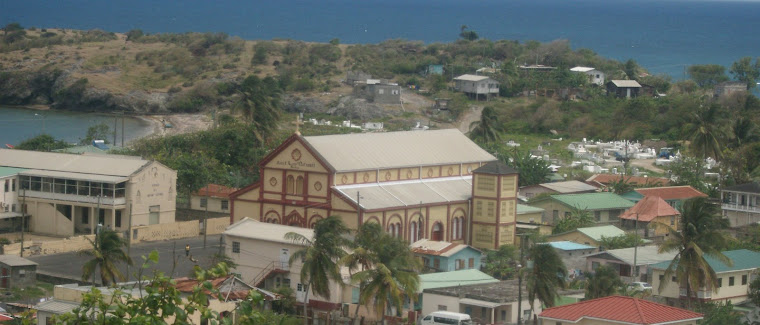
The Light House in Vieux Fort. The views are great and I could see both the Atlantic Ocean and the Caribbean Sea. According to Lenny, the story is that the Light House showed up on the island over one hundred years ago and no one really knows where it came from or who, if anyone ordered it. History is mostly oral and so it is difficult separate myth from reality, but legend is part of the island.

Saturday, December 27, 2008

A Saint Lucian Holiday

Sometimes I hesitate to write about tourism because I don’t want to perpetuate a distorted image of the island. I can’t stress enough that the image we hold of the Caribbean, although true, it is not the story. The real story is the back story. In my opinion, the beauty lies in the villages and with the people. Having established that, tourism is part of the island and one that deserves some space on my page.


In the next few days I will post a series of short posts to describe my Christmas holiday. I’ve already talked about activities in my village; among other posts were Bursting the Bamboo and Nine Mornings. Now I want to take you to see the Saint Lucia that was created to allow visitors to get away from the hustle in their lives and carve a momentary few days out of their lives to relax and unwind.


I try to balance my blog with people, history, culture, and the economy which includes tourism. In the 1970s, starting with Sandals Resort, all-inclusive hotels were allowed to build on the island. The large cruise ships that dot the harbor are all-inclusive. The bulk of money stays within the confines of these resort and sea communities.


Peace Corps Volunteers live in villages, towns, and cities along side people who fish or farm to make a few dollars. Many work behind the scenes to create the environment that visitors enjoy. They are the security guards, grounds keepers, waiters, and hotel maids. They are the people who prepare gourmet meals, take people around the island on water and land taxis, and teach scuba diving or take visitors high among the rain forest in zip lines.


Together, we will be visiting places that are incredible, beautiful, and relaxing, however; after a couple of weeks of exploration, I’m tired and happy to be back at home in my village.


Lenny is a taxi driver and Tour Guide and hosted one of our volunteers into his home during training. He’s driven us around the island before. Easy going with a good sense of humor, he’s a joy to be around. He’s our friend and we would hire no one else. He will take us to see the western part of the island. (If you are looking to book a tour guide in advance you can visit his website http://www.taxi-stlucia.com/pages/1/index.htm. I do not receive any benefits for this small add.)


So, stay tuned. We will be visiting a lighthouse, a cocoa plantation, an incredible beach, and a resort positioned between the Pitons. Then, I will take you to a small village in the north where I spent Christmas Day.

Friday, December 26, 2008

Bursting the Bamboo


One of the Christmas time traditions in St. Lucia is 'bursting the bamboo'. Beginning in November sounds of bamboo bursting are heard. Men in the village use kerosene, rags and sticks as fuses to make cannons out of hollowed-out bamboo. There is a video on YouTube which I've posted for you. It's at the bottom of the blog.