Writings of Saint Lucia, Ghana and life in general. A Peace Corps Volunteer in St. Lucia, visiting faculty in Ghana and grandma for life. This is a look back at the details of my travels and a document for my grandchildren. I hope you enjoy reading it as much as I enjoy writing it. This blog does not express views of U.S. Peace Corps, Webster University, my family, dog or any institutions named or linked to these pages. It's life observation as I interpret it.
Showing posts with label My Village. Show all posts
Saturday, August 7, 2010
Moving On
As I take down pictures and pack memorabilia that I have accumulated over the past two years, I become more aware of the reality that I am leaving. My apartment is beginning to look similar to that which I first entered.
I watch Kevin as he struggles to understand that he will not be able to stream his Sirius Radio because for some reason I can’t seem to get wifi on my wireless. I watch him on Facebook and can’t get his attention so I wire another laptop and start a Facebook Chat with him. As he sits on the porch and I sit in my living room, he chats with my sister in New Jersey and me, just five feet away. The conversation turns to phones and which type will I choose when I return. We conclude there are so many Smart Phones and so little time.
In a couple of days time technology will become my new reality. Saint Lucia is only now beginning to advertise post-paid plans with Blackberries and a gig of usage for a monthly price. They, too, will live in a world where people are tethered to a world of e-communication.
Friday, August 6, 2010
Morning Coffee
I am having my morning coffee on the balcony. It is my last week here in Saint Lucia. I may come back for a visit, but it will never be like it is now. This is my home now, but upon return I will be a visitor. I listen to the roosters crowing, the wind blowing and the dogs barking. It is my last Monday. Just one short week from now, I will be sitting on my porch, holding my dog, talking to my granddaughter and having my first cup of morning coffee while contemplating rejoining the life I left two years ago.
Thursday, August 5, 2010
Dazed
And so my service comes to a close. Kevin, my youngest son, is on island and will be helping me pack and move back home. My mood is both high and low. High, knowing I will see my family, friends and dog. Low, knowing some must figure out how to accommodate yet one more person into this tiny house. High knowing I have left some good sustainable projects behind. Low knowing I must leave my home and friends. High, knowing I will get my hair cut and colored, perhaps visit my spa and stay in the mountains for a few days of rest and relaxation.
I met Kevin at the airport yesterday. I arrived a few minutes early and as I sat waiting for him, I thought about my arrival just two years ago. Everything looks so familiar now and it was so foreign then. I thought about meeting new groups of volunteers and seeing their dazed and tired faces. My thoughts turned to when I arrived in Tegucigalpa a few years ago to visit my oldest son who was Peace Corps Honduras. I wondered if he had the same thoughts as he waited for us to move through customs.
Today we took a morning walk through the village. This is a quiet time. School is closed for the summer and people are vacationing. There are many who will not be available to say goodbye. This will be easier on me, but I’m sorry I won’t see them before I leave.
We stop at a local shop and buy a few pieces of fried chicken and Kevin pours ketchup on top. That’s the way they roll here. As we continue a leisurely stroll, two children stop me and want to touch my hair. Their mother, embarrassed, encourages them to move on. I look over, “They are only curious. It is alright” and I see her relax. I make a comment on the hardships and living conditions of some and Kevin is surprised. “No, I never get use to it”, I say.
A woman sits on the sidewalk selling a few pieces of fruit and some peppers. I see them from a long distance and know they will be perfect for the spaghetti Kevin will make tonight. Ah, for a Saturday, it’s been a good day for hunting and gathering in the village.
When we returned home I made fruit smoothies and Kevin ate his chicken. We sat on the porch and I asked, “So what is the reaction at home?” He responded, “Everyone is in a daze. They all go around looking like this.” He puts a funny dazed look on his face and we both laugh.
Thursday, July 22, 2010
Humm? A new trend? A fashion statement?
My report on New York is being interrupted for this special news bulletin.
Saturday, June 12, 2010
The Long Walk
Sometimes I wonder why we must put people in boxes. We all do it. We see a homeless man or woman on the street and turn our heads. We see a group of minority men and become cautious. We see a well dressed man and see success. It’s no different in Saint Lucia. It’s human Nature. Here, many see a poor man, a Rastafarian farmer, and people become distrustful. This was the case two weeks ago when we walked across the island.
I have a lot of stories to tell, but none like this one. I can only tell the partial story because some of it is far too personal. We made a lot of mistakes that day, but in the end, the mistakes we made were worth the new friendship and bond we gained.
My sister and niece, Janyn and Tracy were visiting and we decided to walk across the island. I read that there is a well-marked path and I do love the rain forest. Elaine decided to come along. One thing led to another and our first mistake was getting a late start . . . 10:30 a.m.
Later I was told people start at dawn for this hike. Why didn’t we have a sense of urgency? I have no idea what I was thinking. We started out from my village. Most people take a ride up the six mile road, but I thought this would be cheating…clearly our second mistake.
We stopped at the village market for water. I bought a big bottle as did Janyn and Tracy. Elaine decided two small bottles would be enough. Really? This is the warmest time of the year and we are venturing out across the island with less than a gallon of water. Our third mistake of the day…not enough water.
We walked across the village and crossed the highway to the six mile stretch that leads to the path. It’s a beautiful walk and many villagers have country farms along the way.

We reached LaTille Falls about two miles into the walk and a friend from the village spotted us. I spoke with her for a few minutes and she warned us about going without a guide.
She said four women should not be alone. She pointed to a Rasta man who was walking up the road and said, “You must be careful of people like him”. One thing you should know about me is that I’m independent. The same is true for Janyn, Tracy and Elaine. None of us needs a man to take care of us. I told her not to worry and we were on our way. It turns out she was right. This was our first warning. We did need a guide and sometimes we do need men to take care of us. You must know I choke while writing those words.
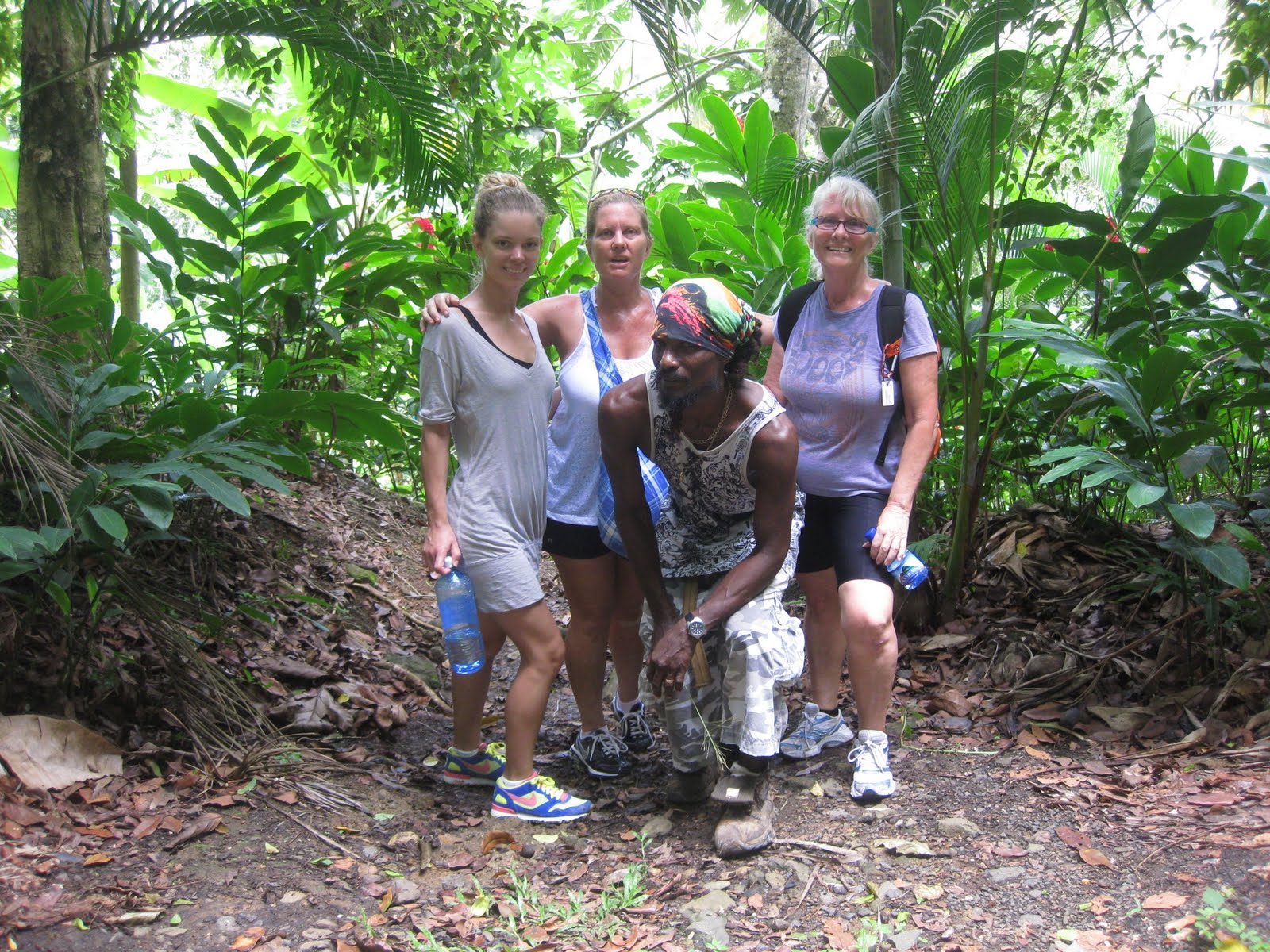
As we walked up the road, we approached that Rasta man. He was throwing a mango at the tree in order to make others fall. I said, “that’s clever”. He asked where we were going and I explained our intended hike. He said, “I’d like to go with you but I have other things to do”. Then minutes later he asked if he could accompany us. I conferred with the others and everyone agreed that he could come along. He told us that God put him in this exact place so that he could accompany us on our walk.
His name is Julian.


We approached the “Country Club” which is a small building in the middle of nowhere. I was amused at the name until I stopped to think about it. The 'club' IS in the country, open to all who pass. They play dominoes and sing Kareoke. There are no dress codes or extravagant entrance dues. Our country clubs are in the city and most are opulent and have tennis courts and golf courses.
I once went to the Los Angeles Country Club and had to wear a dress to ensure my entrance. Luckily, I was with a man, otherwise I would have had to enter through the side entrance. Women were not allowed through the front door...nor were they permitted membership. I think I like the Saint Lucia Country Club better.
Janyn and Julian played a couple of games of Dominoes while we drank our cool beverages. By now it was noon. What were we thinking? A game of Dominoes in mid-day before walking across the island? The forth mistake…wasting time.
Once again we set out for our trek across the forest. It was about 1:30 p.m. when we approached the dirt path through the forest. A man driving a car stopped. He and Julian spoke; they were friends. He got out of his car and gave us handfuls of fruits to take with us. He said we were getting a late start; our second warning. Later, when we were running low on water, we found the fruit refreshing.
The reported well-marked path was indeed marked. At least we did see this sign. The problem was that we couldn't figure it out! And, it was the only one we saw.
We entered the forest and marveled at the beauty. We listened to the sounds…sounds that can only be heard in a rain forest. We heard the calls of birds including those of parots, the Saint Lucia National Bird. The smells were equally tantalizing.
We had made four critical mistakes and ignored two warnings by the time we had walked three hours to reach the entrance of our hike. There were a myriad of other unspoken problems encountered along the way that should have caught our attention and one that should have turned us back.
The last warning sign was sounded by crickets and tree frogs...sounds only heard as the sun goes down and the skies are blackened. My glasses began to fog as the forest humidity raised and I hung them on my shirt as we continued to move in the darkness. We had three cell phones which illuminated our path.
In the darkness of the night, Julian stopped. He said, "do you hear that?" We did. It sounded like bass; maybe drums, definitely music. That was a good moment. We didn’t walk out of the forest until 10:30 that night, a full eleven hours from the beginning of our journey.
At one point, I was ready to make camp in the forest, but at Julian's insistance we kept moving. It turns out that because I bumped into that friend by LaTille Falls, the village knew what we had done and there were people looking for us. Oh dear. How did I get to be this old and this stupid?
As I said at the top of the story, there are secrets that we left in the forest and remain between the five of us. In the end Janyn, Tracy, Elaine and I all agreed that Julian was right:
God sent him to us. He protected us. He kept us going. He is our dear and wonderful friend.
And, by the way, if anyone happens to take this walk and comes across an aqua pair of blended-transition-designer glasses, they are mine.
I have a lot of stories to tell, but none like this one. I can only tell the partial story because some of it is far too personal. We made a lot of mistakes that day, but in the end, the mistakes we made were worth the new friendship and bond we gained.
My sister and niece, Janyn and Tracy were visiting and we decided to walk across the island. I read that there is a well-marked path and I do love the rain forest. Elaine decided to come along. One thing led to another and our first mistake was getting a late start . . . 10:30 a.m.
Later I was told people start at dawn for this hike. Why didn’t we have a sense of urgency? I have no idea what I was thinking. We started out from my village. Most people take a ride up the six mile road, but I thought this would be cheating…clearly our second mistake.
We stopped at the village market for water. I bought a big bottle as did Janyn and Tracy. Elaine decided two small bottles would be enough. Really? This is the warmest time of the year and we are venturing out across the island with less than a gallon of water. Our third mistake of the day…not enough water.
We reached LaTille Falls about two miles into the walk and a friend from the village spotted us. I spoke with her for a few minutes and she warned us about going without a guide.
She said four women should not be alone. She pointed to a Rasta man who was walking up the road and said, “You must be careful of people like him”. One thing you should know about me is that I’m independent. The same is true for Janyn, Tracy and Elaine. None of us needs a man to take care of us. I told her not to worry and we were on our way. It turns out she was right. This was our first warning. We did need a guide and sometimes we do need men to take care of us. You must know I choke while writing those words.
As we walked up the road, we approached that Rasta man. He was throwing a mango at the tree in order to make others fall. I said, “that’s clever”. He asked where we were going and I explained our intended hike. He said, “I’d like to go with you but I have other things to do”. Then minutes later he asked if he could accompany us. I conferred with the others and everyone agreed that he could come along. He told us that God put him in this exact place so that he could accompany us on our walk.
We approached the “Country Club” which is a small building in the middle of nowhere. I was amused at the name until I stopped to think about it. The 'club' IS in the country, open to all who pass. They play dominoes and sing Kareoke. There are no dress codes or extravagant entrance dues. Our country clubs are in the city and most are opulent and have tennis courts and golf courses.
I once went to the Los Angeles Country Club and had to wear a dress to ensure my entrance. Luckily, I was with a man, otherwise I would have had to enter through the side entrance. Women were not allowed through the front door...nor were they permitted membership. I think I like the Saint Lucia Country Club better.
Janyn and Julian played a couple of games of Dominoes while we drank our cool beverages. By now it was noon. What were we thinking? A game of Dominoes in mid-day before walking across the island? The forth mistake…wasting time.
Once again we set out for our trek across the forest. It was about 1:30 p.m. when we approached the dirt path through the forest. A man driving a car stopped. He and Julian spoke; they were friends. He got out of his car and gave us handfuls of fruits to take with us. He said we were getting a late start; our second warning. Later, when we were running low on water, we found the fruit refreshing.
The reported well-marked path was indeed marked. At least we did see this sign. The problem was that we couldn't figure it out! And, it was the only one we saw.
We had made four critical mistakes and ignored two warnings by the time we had walked three hours to reach the entrance of our hike. There were a myriad of other unspoken problems encountered along the way that should have caught our attention and one that should have turned us back.
The last warning sign was sounded by crickets and tree frogs...sounds only heard as the sun goes down and the skies are blackened. My glasses began to fog as the forest humidity raised and I hung them on my shirt as we continued to move in the darkness. We had three cell phones which illuminated our path.
In the darkness of the night, Julian stopped. He said, "do you hear that?" We did. It sounded like bass; maybe drums, definitely music. That was a good moment. We didn’t walk out of the forest until 10:30 that night, a full eleven hours from the beginning of our journey.
At one point, I was ready to make camp in the forest, but at Julian's insistance we kept moving. It turns out that because I bumped into that friend by LaTille Falls, the village knew what we had done and there were people looking for us. Oh dear. How did I get to be this old and this stupid?
As I said at the top of the story, there are secrets that we left in the forest and remain between the five of us. In the end Janyn, Tracy, Elaine and I all agreed that Julian was right:
And, by the way, if anyone happens to take this walk and comes across an aqua pair of blended-transition-designer glasses, they are mine.
Friday, June 4, 2010
Looking for Mommy
Sunday, May 30, 2010
The Food Pyramid
Type II Diabetes in Saint Lucia is of epidemic proportions. Imagine. A lot of starch and sugar is eaten here. I spoke with a woman several months ago about her mother. She had her leg amputated. The woman said to me, “The doctors are very quick to amputate”.
Given this information it made sense to add Nutrition to the structure in the after-school program. An entire month was dedicated to teaching the children about basic nutrition and the food pyramid. They were taught serving size and quizzed about various foods.


Today I went to the store to stock up on regular stuff that I eat. When I brought it home, I studied my purchase carefully. I examined the food group chart and to my surprise the things I purchased fit very well into the pyramid. Maraschino Cherries and dried apricots checks off one serving of the “fruit” group and the Pringles fills the daily requirement for vegetables. Water…check that one. Top Raman – great for the pasta group. Chocolate goes into “fat, oils and sweets”, but doesn’t it count for something that it’s mostly dark chocolate?
Now I could “beef up” the meat group … pardon the pun. But I have a problem with that group. First, I don’t really like meat. I don’t eat anything other than fish and chicken breasts. I really don’t like anything with bones because it reminds me of what I’m eating. I find that thoroughly disgusting. Yes, I know, if I was starving I would eat anything. I’ve heard that argument before. It’s just that I’m not starving.
But there is a bigger problem. Chickens in our village are fully equipped with backs, legs and thighs, but they don’t have breasts – seriously. If they do, they are hiding them from me because I’ve never been able to find them in the store in my village. I stalked this chicken to see it was hiding a breast, but I couldn’t really tell. It doesn’t matter anyway because I don’t cook. Fortunately for me I love almonds and exist on peanut butter … so I can check off the “protein” group.
I was talking to a Peace Corps friend yesterday. (You know who you are but I’m keeping your identify a secret to protect you. I’m a good friend and you may thank me later.) She had potato chips and coke for dinner. I’m sure she washed it down with a boatload of dark chocolate, but she didn’t confess to that. We both laughed before silence overcame us as we quietly reflected on what she had just said. I said, “Do you think we are going to live through this?”
Given this information it made sense to add Nutrition to the structure in the after-school program. An entire month was dedicated to teaching the children about basic nutrition and the food pyramid. They were taught serving size and quizzed about various foods.

Today I went to the store to stock up on regular stuff that I eat. When I brought it home, I studied my purchase carefully. I examined the food group chart and to my surprise the things I purchased fit very well into the pyramid. Maraschino Cherries and dried apricots checks off one serving of the “fruit” group and the Pringles fills the daily requirement for vegetables. Water…check that one. Top Raman – great for the pasta group. Chocolate goes into “fat, oils and sweets”, but doesn’t it count for something that it’s mostly dark chocolate?
Now I could “beef up” the meat group … pardon the pun. But I have a problem with that group. First, I don’t really like meat. I don’t eat anything other than fish and chicken breasts. I really don’t like anything with bones because it reminds me of what I’m eating. I find that thoroughly disgusting. Yes, I know, if I was starving I would eat anything. I’ve heard that argument before. It’s just that I’m not starving.
I was talking to a Peace Corps friend yesterday. (You know who you are but I’m keeping your identify a secret to protect you. I’m a good friend and you may thank me later.) She had potato chips and coke for dinner. I’m sure she washed it down with a boatload of dark chocolate, but she didn’t confess to that. We both laughed before silence overcame us as we quietly reflected on what she had just said. I said, “Do you think we are going to live through this?”
Sunday, May 23, 2010
The End Nears
It was a strange day today. I know that I’m coming close to the end of my service, but today there was a lot of reality in the mix.
I heard the car pull up and opened my door. Brenda was walking up my steps. A big smile greeted me. We chatted for a few minutes until there was another knock. I opened the door and welcomed two Peace Corps staff, Sharmon and Elizabeth. Every few months they come by to see how things are going. But, this meeting was different. Rather than focusing on future projects, the focus was on past accomplishments.
We spoke about the work I am doing, about a previous Peace Corps Volunteer accomplishments, about my village and then the conversation turned. Sharmon asked, "Have you thought about what you will do when your service is completed?" Have I ever! I thought about that as I pressed the send button to start the Peace Corps application process over three years ago. Do I have an answer? ABSOLUTELY!….not.
I explained that I am very goal oriented. This is another chunk of my life and like everything else I've done, I want to understand the purpose of why I'm doing it. So here I was, talking about the subject that brought me here in the first place. As we spoke in nonsensical words, I silently thought, “I was a wife and a mother. I had a long and full career. I taught courses after I retired. I hoped that I could do something meaningful for a couple of years that would spark an idea about what I might do next. Now here I am almost two years later and I am no closer to the answer than I was when I was standing in the Los Angeles International Airport waving goodbye to my family.”
Later I opened an email from a university where I previously worked. In the past couple of months there’s been conversation around my return. Although we agreed that I would come back and teach, I was stunned when I read the sentence. The words cut through me, “We are preparing for your return. Please review the note below from main campus and if you need to make changes send us an email.” I’m not sure why those words stopped me cold, but it could be mounting reality.
After reading the email, I thought about my life. It’s exciting to come to the end of service, but it’s also bittersweet. I hear Brenda talk about future projects she will be doing and I will miss the interesting work. I helped Angelina write a proposal for a Peace Corps Response Volunteer and I wish I could tackle this assignment. I will miss the children in which I see amazing daily progress at the after-school program and I will miss creating and facilitating workshops for professionals around the island.
Later in the afternoon I walked down the long road to the highway to catch a bus to Mon Repos, a nearby village. Within minutes, a bus stopped to drop a passenger. (I should note that there are two bus routes that can take me to Mon Repos; one that goes all the way to Castries, and another that only goes as far as Mon Repos.)
The bus was full and I took the last seat. Almost in unison, every passenger on the bus said, “This bus doesn’t go to Castries”. I responded quickly, “I’m just going to MoPo.” There was laughter in the bus and a woman in the back said, “She said MoPo! She doesn’t say Mon Repos. She’s one of us!” I spent a few hours with the after-school program children and facilitators. I helped with homework and answered questions. I watched them learn to play tennis and do art projects.
When I returned to my village, it was dark. I called to the driver, "stopping at the junction", paid him $1.75EC, the equivalent of $.65. It is hot and people are sitting outside to feel the cool island breeze. I love walking through the village and always get out at the far end to extend my stroll. I wave to an old man who stands at the window of his darkened home watching the world pass by. I suppose life without electricity is normal in his world. I pass by the football (soccer) field and hear the children shouting “Miss Karen!” I walk by small shacks and wonder if the people who live in them are happy. I walk by several rum shops with various genres of load music drowning out the crickets and tree frogs. I see the occasional spirited game of Dominoes being played on a makeshift table.
I heard the car pull up and opened my door. Brenda was walking up my steps. A big smile greeted me. We chatted for a few minutes until there was another knock. I opened the door and welcomed two Peace Corps staff, Sharmon and Elizabeth. Every few months they come by to see how things are going. But, this meeting was different. Rather than focusing on future projects, the focus was on past accomplishments.
We spoke about the work I am doing, about a previous Peace Corps Volunteer accomplishments, about my village and then the conversation turned. Sharmon asked, "Have you thought about what you will do when your service is completed?" Have I ever! I thought about that as I pressed the send button to start the Peace Corps application process over three years ago. Do I have an answer? ABSOLUTELY!….not.
I explained that I am very goal oriented. This is another chunk of my life and like everything else I've done, I want to understand the purpose of why I'm doing it. So here I was, talking about the subject that brought me here in the first place. As we spoke in nonsensical words, I silently thought, “I was a wife and a mother. I had a long and full career. I taught courses after I retired. I hoped that I could do something meaningful for a couple of years that would spark an idea about what I might do next. Now here I am almost two years later and I am no closer to the answer than I was when I was standing in the Los Angeles International Airport waving goodbye to my family.”
Later I opened an email from a university where I previously worked. In the past couple of months there’s been conversation around my return. Although we agreed that I would come back and teach, I was stunned when I read the sentence. The words cut through me, “We are preparing for your return. Please review the note below from main campus and if you need to make changes send us an email.” I’m not sure why those words stopped me cold, but it could be mounting reality.
After reading the email, I thought about my life. It’s exciting to come to the end of service, but it’s also bittersweet. I hear Brenda talk about future projects she will be doing and I will miss the interesting work. I helped Angelina write a proposal for a Peace Corps Response Volunteer and I wish I could tackle this assignment. I will miss the children in which I see amazing daily progress at the after-school program and I will miss creating and facilitating workshops for professionals around the island.
Later in the afternoon I walked down the long road to the highway to catch a bus to Mon Repos, a nearby village. Within minutes, a bus stopped to drop a passenger. (I should note that there are two bus routes that can take me to Mon Repos; one that goes all the way to Castries, and another that only goes as far as Mon Repos.)
The bus was full and I took the last seat. Almost in unison, every passenger on the bus said, “This bus doesn’t go to Castries”. I responded quickly, “I’m just going to MoPo.” There was laughter in the bus and a woman in the back said, “She said MoPo! She doesn’t say Mon Repos. She’s one of us!” I spent a few hours with the after-school program children and facilitators. I helped with homework and answered questions. I watched them learn to play tennis and do art projects.
When I returned to my village, it was dark. I called to the driver, "stopping at the junction", paid him $1.75EC, the equivalent of $.65. It is hot and people are sitting outside to feel the cool island breeze. I love walking through the village and always get out at the far end to extend my stroll. I wave to an old man who stands at the window of his darkened home watching the world pass by. I suppose life without electricity is normal in his world. I pass by the football (soccer) field and hear the children shouting “Miss Karen!” I walk by small shacks and wonder if the people who live in them are happy. I walk by several rum shops with various genres of load music drowning out the crickets and tree frogs. I see the occasional spirited game of Dominoes being played on a makeshift table.
I see roosters protecting their hens, dogs sleeping on the streets and goats chomping on weeds. I hear people sitting on the roadside say, “Karen, are you passing?” And, then I softly climb the stairs to my apartment trying to be careful not to bother Elizabeth and John, but know they are watching for my safe return.
I have had a lot of emotions while living here, but I rarely thought I would be sad to leave. I suppose I never let myself think about this reality. It isn’t that I didn’t want to stay. It’s that I knew this was a twenty-seven month assignment and that I would leave. It’s temporary. I knew this then and I know it now. The thing is that after two years, this village has become my home.
Sunday, May 16, 2010
The Street
The people live in the village. They cheer, encourage and celebrate with the children. The intensity and excitement are palpable. The finish line is only a few steps away and with each step the voice of the crowd increases by another decibel. Some bystanders are caught up in the moment and begin running with the children who are about to cross the finish line. This is one of those moments when the people in the village are one; everyone has the same focus; like-minds. It’s Sports Week and this is a happy occasion.
At first glance, this is just a street; one of thousands on the island. It stands tall and straight, sloping down into the village where people lime. This is where people unwind, talk about their day, commiserate about their problems and drink a Piton. This street has witnessed happy, sad and mundane days.
They come from the fields; the farms in the interior portion of the island. Cutlass in hand and dirty from a days work, their pick-up trucks are filled with “green gold”. Banana farmers are rich in soil and that allows them to reap the bounty of their harvest. Truck after truck cruises down the hill headed to the nearest collection point where the farmer will trade in the harvest for cash. It’s just a normal day in the village. At least it was normal until the export laws changed.
It was a familiar sight, but not familiar at all. They are waiting to see the old pick-up truck that they have seen rolling down this street so many times before. The street is lined with people, not a standing space left. It is quiet. There is little to say. Each is grieving in their own way, going over small memories in these private moments. And then, it appears. It is small in the distance, but as it moves closer the reality becomes unbearable. A sob is heard and then a cry. The people begin to scream and some collapse in the street. The little pick-up truck holds the casket of their fallen leader. Sir John Compton had done so much for this village.
The village was bustling, especially on a Saturday. Neighboring villagers would come to do their weekly grocery shopping, buy a new pair of shoes or buy schoolbooks for the children. It was difficult to move around the island in those days, but the street in this village was well-travelled with buses transporting shoppers who left handfuls of money in retailers ringing cash registers. When the main road was built, shoppers changed their path in pursuit of a more diverse shopping experience in Vieux Fort. The cash registers that once left ringing in our ears, now stand silent for the most part.
This street has witnessed change in the village, the era of green gold, a hero, Sir John Compton and buses filled with shoppers. These are just a few memories that make this street a historical timeline of the village culture. But new memories are made; the cheers for children, running as fast as their feet will take them, replace the sweat of the farmers, the ringing cash registers and the tears for their leader.
Wednesday, May 12, 2010
Paper Beads
The Hub
There is a lot to say before we get to the point. The point, of course, is paper beads. But, I need to tell you how I got there in order for you to appreciate them.
I have my own Communication Center in Saint Lucia. The first feature of my Communication Center is my phones; I have lots of phones. I have a cell phone. I need it when I’m out and about. I’m not really good with it because I carry a backpack instead of a purse. It gets lost in my backpack so I put it in my pocket. It’s sensitive and turns itself off a lot. My friends know to send me an email when I don’t answer the phone.
I went through a period when I forgot to take it out of my pocket and washed a lot of phones in my semi-automatic washing machine. That was expensive. I solved the problem. I put a crumpled piece of paper in the washing machine. The paper was a symbol for me to find my phone before turning the water on. It worked; I haven’t washed a phone in months. Unfortunately, the phone that survived is the one that likes to turn itself off.
I have a landline. I need it to call other landlines because it costs more to dial a landline number from a cell phone. I may not have opted for this and just paid the extra cost, but I couldn’t get internet without getting a landline. Why? Well, the only thing I can figure is that when I arrived on the island there was no internet competition.
A lot of people carry two cell phones. We have two carriers and it’s expensive to make calls between the two companies. Some people wear their phones around their necks. Here is where I draw a line in the Caribbean beach sand. I will only have one cell phone and you will never catch me wearing it around my neck.
Many of the locals use texting to communicate. I became a “texter” when I began teaching at Los Angeles Harbor College. Students texted me to say they were late or couldn’t make it to class and for a myriad of other things they wanted to communicate. It’s not my preference, but I used it then and use it now.
I have a Vonage Phone. I know, I should have a Magic Jack. It’s a cheaper option, but I brought the Vonage box and, frankly, it’s too much trouble to switch. The Vonage Phone is hooked up to the internet and has a California area code so that people can call me and I can call them. It’s nice.
Another feature of the Communication Center is the internet. I rely on it for work and to keep in touch with friends. I research. I don’t have to GO to a library to get information. I use the internet to research material for courses and workshops. As alumni and faculty, I have access to several university libraries. Email is important. Occasionally, I use Skype when I want to see the people I’m talking to. It’s fun, but the pictures are less than clear so this Communication Center feature is not often used.
I have a Facebook account. Most of the volunteers have a Facebook Account and so it’s a good way to keep in touch. I use chat. I chat on Facebook and Gmail. I usually don’t initiate the chats, but I do chat. It’s definitely part of my Communication Center. And, of course, I’m a blogger. It’s my way of keeping in touch with a wide group of friends. Even if I don’t know you, by now you are my friend.
I pay bills on-line and occasionally make a purchase. Recently, I purchased two books from my friend Lois. She co-authored a new book called “Carried Away”. I’m a Paypal user which makes it easier to make purchases.
I recently sent two real letters using real stamps, something I haven’t done in years. It was different and fun, but I don’t feel like I’ll make it a habit. I prefer to use my Communication Center.
My Communication Center is a hub – a web of activity. Three phones, Skype, email, chat, texting, a bill paying and purchase center, a research tool, Facebook and Blogging. My Communication Center is a delicate balance of software, hardware, devices, wires and cables. As I recently found, it can be a house of cards.
Denial
When I returned from my trip to Costa Rica, I found my landline didn’t work. Although the landline is part of my Communication Center and is included in my Hub, it has less value to me. I looked at the dead phone sitting on the table and thought to myself, “I will report it just now”. In the meantime, I will pretend there is no problem. It’s just easier that way.
‘Just now’ in Saint Lucia means maybe in five minutes, maybe in a few hours, maybe tomorrow, next week, or maybe never. It’s pretty vague. Island living has compelled me to adapt this lack of urgency; at least when I choose to adapt to it.
I was in Castries last Tuesday and had a little free time. I wasn’t sure if I had paid the phone and internet bills yet so I stopped at Lime, my phone/internet carrier. This is another ‘just now’ thing. I’ve forgotten to pay my bills for two months and no one says anything. They never threatened to cut my service or even mention that the bill was overdue.
So, this is the way I roll in Saint Lucia. I go to the office and stand in line. I don’t like carrying a lot of money and prefer to pay the bill with a credit card. Sometimes after standing in the Lime line, I have to go to the bank and stand in line to get money and then return with cash to pay the Lime bills. I do this when the credit card machine doesn’t work. I’m used to the process. I patiently accept this. It’s part of Peace Corps charm.
The credit card machine worked yesterday. I hesitated because I thought I may be directed to another line, but mustered the courage. “My landline doesn’t work. How do I report this?” Much to my surprise she took the information right there. She punched information into the computer, asked a couple of questions and then said, “A repairman will be out within three days”. I thought to myself, “yes, or just now”. But as I said I have no sense of urgency about this phone.
I was working with the children in a neighboring village when my cell phone rang the next day. It always startles me when it rings because it shuts itself off so often. Anyway, it was the repairman! He explained he had fixed the problem from the little station in the village, but wanted to check to ensure everything was working properly. He needed to know how to locate my house.
This is always a chore because there are no street names of numbers. I explained in painful detail how to get to my house and then asked him to knock on my landlord’s door and ask them to let him in the house. I am convinced he either lives in this village or knows someone here because he understood every landmark I described.
Anger
When I got home I found that not only was the landline dead but I also have no internet. OMG, my entire Communication Center – the delicate balanced hub of activity has been disturbed. I cannot get phone calls from the U.S., can’t skype, make purchases, pay bills, research, email, chat…Nothing. I realize I don’t have a clue what I should be doing because I can’t access my on-line calendar. My communication hub is now confined to one phone; my cell phone. Whereas just yesterday the world was at my fingertips, my world has been reduced to one tiny island – Saint Lucia. Just now is not acceptable!
Little did I know that I would miss five days of work, make dozens of costly phone calls from my cell phone to LIME’s landline, experience success and then failure and that it would take over week to fix the problem. But, there is something about those frustrating and bad experiences in life that turn out to be introspective and humorous.
Frustration
At the After-School Program, the focus for the month is slavery. We are teaching the children to think broader. I asked them what it meant. They said that it meant that people were beaten but couldn’t come up with meaning beyond that. I asked them to find the definition of slavery on the computer. They discovered that it was when someone was forced to do something they did not want to do.
We talked about what they were “slaves” to in their world. They came up with a list of things. We talked about peer pressure. We talked about drugs and alcohol. As we explored this concept they began to understand that, although slavery in the more literal sense was devastating, wrong and frightening, they reasoned that they are slaves in a sense to things in their world. Just like slaves, it takes brave people to overcome the adversity.
As I sit here, isolated in my darkened room, feeling sorry for myself, frustrated and alone, I think about the discussion with the children. I conclude, I am a slave to my Communication Center. I, too must be brave. I shall overcome. Really? NO! I don’t want to overcome – just put my house of cards back in order….please.
Acceptance
Morning finally arrived. I made it through the night. One entire day without full use of my Communication Center and I’m still breathing. I made a pot of coffee, turned on the news and began tapping my finger. Would the repairman show up? Would it be today, or just now? I went downstairs and Elizabeth came out. She said, “Don’t panic, he will show up”.
He scampered up the phone poll and ran up my stairs to test, repeating this process several times. And all the sudden – the internet. The world again is at my fingertips. It was almost like I’d never known such peace. I slept well Thursday night. And then came Friday.
The LIME technician said, “I just fixed your line, can you test it?” “What?” I respond, “There was nothing wrong with my line!” For several seconds, the only thing I heard the technician say was, “Oh, sugar”. He said this many times. I asked, “Did you break it?” He could not answer. He only said “Oh, sugar”. I knew the answer.
It has now been eight days. So here’s what has been happening. Last Tuesday, I reported the landline was dead. My internet was fine. Wednesday they came and broke the internet so I had no phone or internet. Thursday Digby fixed it. Friday the unknown “Oh, sugar” man broke it, closed the ticket and left. No one works weekends. Monday I opened a new ticket. Tuesday they said they were here in the village trying to fix it from the LIME office. I’m not sure if there is any truth to that. They also indicated they couldn’t fix it and would be back today. I’m not sure there is any truth to that either.
My landlady, Elizabeth, came to my house today with a piece of homemade cake and said she was going to Vieux Fort and would put “threatening LIME” on her list of things to do while there. I’m not sure why, but she is still in the “anger” stage. I need to help her get to “acceptance”.
So, what am I doing to make this tolerable? I’m making paper beads.
Paper Beads
I used to grow things when I was younger. When John and I were first married, we had a communal vegetable garden complete with a scarecrow. We lived in a three-plex and we were all friends. The first year we planted twenty-six tomato plants, not realizing that many plants would likely supply the entire neighborhood with tomatoes.
I had hundreds of houseplants. I took the curtains down and the plants supplied our privacy. I remember sitting on the front porch with my oldest son, then two. Together we repotted plants, added nutrients to the soil and watered them.
I made lots of Christmas decorations and usually had a needlepoint on hand to sew. I macraméd and crocheted. Most surprising is that I also cooked and baked. We barbequed in the yard we shared with our friends. No one had much money then so communal dinners were not only fun, but a survival strategy.
After a handful of years, we bought a house and moved from the three-plex. Slowly life began to take hold. Two more children, Little League, school functions, a full time job, long hours and travel, a lawn that needed to be mowed, walls that needed paint and laundry that needed to be washed, replaced the hobbies that previously took so much of my time.
I was never really great at any of the things I did, but the hobbies were relaxing. I didn’t stop doing all those things at once – it was a slow change. Slow enough where I didn’t really notice.
And now, there is another change. A slow change, but significant. There are no longer children to take care of and all the things that go with it. I retired from my job and I gave my lawn mower away and hired a gardener. I signed up for Peace Corps and moved to another country where I live in a rented apartment so there are no walls to paint. I stopped cooking years ago, although I still occasionally bake; even here.
Technology now takes up most of my time. Internet research and work that requires a computer, online videos, music, blogging, emails, Facebook, chats, and perusing websites that supply endless stories written by unknown but talented writers in need of an audience – these are the things that now take up my discretionary time.
The internet is my diversion when I work. It’s my break – the way I clear my head. An hour of work – then thirty minutes of surfing into the black hole of time.
I tried turning on the television, but was bored. I’ve read everything interesting and the only books I have left are books that I started but found less than engrossing. I listen to my IPod, but long to multitask so I clean.
While I was cutting and gluing, I thought of the hours I spent on past hobbies and the peace it brought me. It was fun and relaxing. It was also rewarding because I had something to show for my time. It’s nice to get back to basics, but I do miss the internet!
Friday, April 23, 2010
I am not a Farmer
As the bus neared the Castries Business District there was a sudden traffic jam. This was very unusual. My first thought was that there is a traffic accident. My last thought would have been that a mother hen was frantically herding her chicks to safety. With feathers flying she focused her attention on each of the five chicks herding them with skill. I could feel her panic. She knew the danger to herself, but like any mother she was focused on her chicks, not herself.
The cars, buses and trucks were stopped and drivers and passengers patiently waited while being entertained. I smiled as I realized this was just another Peace Corps moment to enjoy. It was a special moment to reflect on the difference between a city in Saint Lucia and a city in Los Angeles.
The first thing I must do is remind you that I am not a farmer and, thus, I’m not verse in farming technique and animal behavior. I don’t grow crops or raise pigs. There are only a few cows on the island and I most certainly have nothing to do with them. There are no roosters….wait, yes, there are roosters! Lots and lots of roosters.
There is a looming question which has entertained my mind since arriving in August 2008. It generally comes up around three o’clock in the morning. I’m awakened by sounds. No, it’s not the singing crickets or the tree frogs calling – I can sleep through their noise. It’s not the barking dogs – no, they are the ones who kept me up until midnight but now they are sleep. It’s not the slaughtering of pigs – that happens on Friday mornings after daybreak.
I’ve been asleep for three glorious silent hours and it’s a new breed expressing themselves. It starts with just one lone voice in the night and instantly everyone is communicating. Some are heard in the distance, but there is inevitably one intruder lurking under my window who weighs in on the conversation.
I’ve been wondering for sometime now: Why do roosters crow? The bottom line is that they are territorial. They crow to let others know where they are and to ensure they are spaced properly. A rooster’s purpose in life is to protect the flock from all threats at all costs including fighting to the death.• Some roosters are quite docile and will sit in your lap, others will eat your kitten, puppy or small child.
• Very few roosters will get along without fighting and tearing each other up; others are highly aggressive.
• Their entire focus and purpose in life is to insure proliferation of the species
• A ratio of 10 hens to 1 rooster are needed to satisfy these creatures!
• A rooster will sacrifice himself to protect the flock.
Alright, so what you are likely saying at this point. Who cares? Well, read on. Crowing can start when there is a disturbance in the coop or when a car alarm sounds at night. A friendly neighbor simply switching on a porch light can cause every rooster’s crow in the village to sound a high alert.
As I wrote this piece, I kept thinking to myself: what is the purpose of telling people about this mundane phenomenon? Then it came to me…the message…the thing I want people to know in my village:
Will you please stop turning on your porch lights at three o’clock in the morning? I really need some sleep!
Saturday, March 20, 2010
Frustrating Meetings
I have attended several meetings for this organization in the past. Leadership was poor and the meetings were increasingly frustrating. As a result, nothing was getting done and I realized this wasn’t the best use of my time.
I was surprised when I sat down at a recent meeting with this organization. There was enthusiasm. People were volunteering to do things to move forward and ideas were flowing. Then, I looked around and noticed the leader was not present.
There was a mix up in communicating the meeting. Many members weren’t there because the communication process didn't work. The consensus was to send out a new meeting notice for the following week and resume the rich conversation they had started that evening. It was all very exciting and hopeful.
At their insistence, I attended the meeting the following week. When I walked into the room, the leader was there. The focus of the meeting turned to members who have wronged the leader who was not invited to the last meeting. The momentum and any hope of progress came to a screaming halt.
Then, much like an archeological dig, the complaints went further and further. Each shovel of dirt uncovered another tidbit of wrong-doing. And with each shovel, I could see the members sinking further into the abyss of powerlessness and hopelessness.
By the end of the meeting, they were just sitting there being lectured to with no vision, no enthusiasm, no commitment, no participation and no volunteering to move forward. And worse, no leadership.
I was surprised when I sat down at a recent meeting with this organization. There was enthusiasm. People were volunteering to do things to move forward and ideas were flowing. Then, I looked around and noticed the leader was not present.
There was a mix up in communicating the meeting. Many members weren’t there because the communication process didn't work. The consensus was to send out a new meeting notice for the following week and resume the rich conversation they had started that evening. It was all very exciting and hopeful.
At their insistence, I attended the meeting the following week. When I walked into the room, the leader was there. The focus of the meeting turned to members who have wronged the leader who was not invited to the last meeting. The momentum and any hope of progress came to a screaming halt.
Then, much like an archeological dig, the complaints went further and further. Each shovel of dirt uncovered another tidbit of wrong-doing. And with each shovel, I could see the members sinking further into the abyss of powerlessness and hopelessness.
By the end of the meeting, they were just sitting there being lectured to with no vision, no enthusiasm, no commitment, no participation and no volunteering to move forward. And worse, no leadership.
The meeting was pulled back into their circle of ineffectiveness and I was pulled back into the memory that this is the reason I stopped attending these meetings.
Monday, March 15, 2010
Jacks
I remember playing Jacks as a child. It was a matter of coordination. Sort of like rubbing your stomach and patting your head at the same time. The first time player usually finds it difficult, but once the rhythm is found, the game is easy.
It is an inexpensive game, easy to play; easy to transport. All I needed was a small rubber ball and a few jacks, a relatively cheap purchase at the local dime store. Dime stores, which sprang up in the late nineteenth century, slowly began disappearing in the 1960s.
My mom shopped at both Newberry’s and Woolworths, although Newberry’s was preferred. I went with her often, usually to buy patterns and cloth. She sewed many of our clothes and most of my doll clothes. The store had wood floors. When I close my eyes, I can hear the clomping of shoes and smell the scent of large bolts of material. I would wander through the store while my mother looked through huge books to choose a new Vogue Pattern.
I was usually allowed to buy some candy, a squirt gun or a small toy. I remember standing in line with my mother. She had thread, material and patterns in her hand. I had a small package of Jacks. Newberry’s and Woolworths both quietly gave way to the next generation; the discount store, Akron and Gemco which yielded to Walmart and Target.
Did you ever wonder about the origins of the game jacks? Neither did I. Well, that is until I saw a group of children in my village sitting on the ground with a pile of rocks. According to various sources on the internet Jacks is one of those games that children invented during ancient times and long before commercial toys were available. Rocks and bone fragments were used to play the game.
And, to think I’ve lived this long not knowing this little piece of trivia.
It is an inexpensive game, easy to play; easy to transport. All I needed was a small rubber ball and a few jacks, a relatively cheap purchase at the local dime store. Dime stores, which sprang up in the late nineteenth century, slowly began disappearing in the 1960s.
My mom shopped at both Newberry’s and Woolworths, although Newberry’s was preferred. I went with her often, usually to buy patterns and cloth. She sewed many of our clothes and most of my doll clothes. The store had wood floors. When I close my eyes, I can hear the clomping of shoes and smell the scent of large bolts of material. I would wander through the store while my mother looked through huge books to choose a new Vogue Pattern.
I was usually allowed to buy some candy, a squirt gun or a small toy. I remember standing in line with my mother. She had thread, material and patterns in her hand. I had a small package of Jacks. Newberry’s and Woolworths both quietly gave way to the next generation; the discount store, Akron and Gemco which yielded to Walmart and Target.
And, to think I’ve lived this long not knowing this little piece of trivia.
Wednesday, March 3, 2010
Contemplating Coconuts
Maybe he is an artist. He collects coconuts and he is going to do some artistic project that has a message only seen from an aerial view. That seems like a lot of work for just a few lucky people who can afford a helicopter to fly by to witness some obscure message. And, come to think of it, I don’t think I’ve actually seen any helicopters fly by my village.
Alright, I can likely reject the artist idea, but I’m keeping the roof repair on the list of possibilities. Maybe he just has too many coconuts and doesn’t know what else to do with them. Maybe his house is filled with coconuts and he has no where else to put them; now he will begin stacking them on his roof. No, that’s just silly.
Oh, I know, he is feeding the birds! Do birds like coconuts? I’ve never seen a bird eat coconuts before. This man must love birds! Then I think to myself, “Karen, none of this makes any sense!”
So this was my entertainment during my first and second cup of coffee one morning. I used my imagination to think of every possible reason why this man has large burlap sacks of coconuts that he hauls onto his tin roof, spreading them out one by one.
I brainstorm quietly, coming up with reason after reason for this curious behavior. When I can no longer come up with anymore brilliant ideas I decide to do the only logical thing I can think of to solve this mystery. I stood up and walked over to the edge of my deck, “Excuse me sir. Would you mind telling me why you are putting coconuts on your roof?”
It was then that he patiently explained he was setting them out to dry. It would take two, perhaps three days for them to dry. Once dried, he will retrieve them and separate the meat from the shell which he will sell in Soufreire where they manufacture coconut oil.
While I was drinking my coffee and watching this man drag bag after bag of coconuts onto his roof, I was looking for a complex answer. I failed to see the simple answer.
Saturday, February 27, 2010
Water Trucks
The trail is famous for its two cascading waterfalls and pools at the head of the Troumassee River. It rises in the centre of the island, flowing to the mouth close to my village.
This is where my village accesses water. We don't get our water from the Dam in the north that is losing water at the rate of one foot per day. And this is the reason why I still have water when much of the rest of the island suffers for days with dry pipes. Lately, I have seen small tanker trucks in my village and wondered about them. A few days ago Angelina explained the trucks were transporting water to other parts of the island.
The country's water system is in disrepair. Much of the water traveling through the pipes never arrives at the faucet. It has been estimated that up to 50% of the water escapes through the leaks in the pipes.
When I first arrived on the island in 2008, there were meetings about this situation. An outside foreign company proposed management of the water system, fixing the broken pipes and creating a more efficient water system.
I don't know where the proposal ended up, but I do know that people were complaining that their water bills would rise if this was allowed to happen. Now the proposals include deep-well drilling, desalinization and buying water from Dominica. The government is hoping Saint Lucians will buy large storage tanks to house private emergency water supplies.
I don't have the full picture, only pieces of a broken system in an emergency state. Still, in the absence of all the facts, it is alarming - and likely a glimpse into the future of Saint Lucia.
Tuesday, February 16, 2010
BUILDING BLOCKS
I went to Europe with my friends, Linda and Jayne a few years ago. We visited Delta Works, built by the Dutch. It was an amazing sight to see their daily battle with water. The dam was built to hold back the ocean water and was awe-inspiring.
I assumed they consulted with world experts to find out how to build these structures. Surely, the engineers in the United States must have come here to teach them to build these cement monsters. A little naive, isn’t it? They are the world experts and we consulted them after Katrina.
I’m still learning at my age that I need to “undo” many of the stereotypes I was taught in school as a child. As I write this, I remember: Oh yes, this is exactly what the 60s was about; thinking for ourselves and finding truth.
So, here is the story. A large flatbed truck pulled up in front of the house. The driver opened the door and jumped out and onto the back of the truck onto the pile of gray blocks. He put his gloves on and began unloading the cement blocks and neatly stacked them in front of Elizabeth’s house.
I assumed they consulted with world experts to find out how to build these structures. Surely, the engineers in the United States must have come here to teach them to build these cement monsters. A little naive, isn’t it? They are the world experts and we consulted them after Katrina.
I’m still learning at my age that I need to “undo” many of the stereotypes I was taught in school as a child. As I write this, I remember: Oh yes, this is exactly what the 60s was about; thinking for ourselves and finding truth.
I watched as they were unloaded, thinking how hard this work must be. Each block probably weighs at least ten pounds and there are way too many to count.
The blocks are made by mixing cement and pouring it in a mold. Each block is handmade. Now I am the first to admit I know little about building a house, but I do know enough to be intrigued when watching Saint Lucian’s construct buildings.
Homes are either constructed of wood or blocks. The newer wood structures seem to be made of plywood, whereas the old ones are more carefully and artfully constructed using wood brought down from the rain forest. These homes have handmade windows and shutters and decorative cutouts. It's easy to see a craft with love and care that construction workers had many years ago. The more modern homes, like mine, are constructed of blocks and set into cement floor foundations.
Early into this adventure and during my home stay, I watched the workers build an addition across the street. My first thought is that they have no idea how to construct a building. Then I remembered my thoughts of the Dutch and Delta Works.
The blocks are made by mixing cement and pouring it in a mold. Each block is handmade. Now I am the first to admit I know little about building a house, but I do know enough to be intrigued when watching Saint Lucian’s construct buildings.
Homes are either constructed of wood or blocks. The newer wood structures seem to be made of plywood, whereas the old ones are more carefully and artfully constructed using wood brought down from the rain forest. These homes have handmade windows and shutters and decorative cutouts. It's easy to see a craft with love and care that construction workers had many years ago. The more modern homes, like mine, are constructed of blocks and set into cement floor foundations.
Early into this adventure and during my home stay, I watched the workers build an addition across the street. My first thought is that they have no idea how to construct a building. Then I remembered my thoughts of the Dutch and Delta Works.
These are the construction workers who build structures to withstand hurricanes. Many of these buildings were here during the worst hurricanes. They remain standing when they receive more rain in one season than Los Angeles will see in a generation. Humm, it seems to me the houses in Los Angeles slide down mountainsides when a few more inches than normal descend upon the land.

As I observed the construction of Elizabeth and John's new addition, I was not surprised that power tools were seldom used. Picks, shovels, sticks and large pieces of bamboo are standard. There was also a handmade broom, made from bamboo and banana leaves. Any nails that are used are nailed by hand – there’s no nail gun. Nails that are bent are not thrown away, but hammered straight and re-used. Cement is mixed in the street and shoveled into small buckets and hoisted with ropes to the taller areas.
The structure begins to take shape. They leave openings for the windows. This is one of the few places where wood is used. They will construct frames and attach it with nails and of course more cement. Once that is done they will make a wooden structure for the ceiling and, yes, poor cement on top of it. That will be my new extended balcony.
The railing is made of decorative ballisters. Ballisters are popular on the island. They are made of cement from molds that are reused. I talked to one man who makes them. He can make four per day. They each have a metal rod through them and are left in the sun to harden.
As I observed the construction of Elizabeth and John's new addition, I was not surprised that power tools were seldom used. Picks, shovels, sticks and large pieces of bamboo are standard. There was also a handmade broom, made from bamboo and banana leaves. Any nails that are used are nailed by hand – there’s no nail gun. Nails that are bent are not thrown away, but hammered straight and re-used. Cement is mixed in the street and shoveled into small buckets and hoisted with ropes to the taller areas.
The structure begins to take shape. They leave openings for the windows. This is one of the few places where wood is used. They will construct frames and attach it with nails and of course more cement. Once that is done they will make a wooden structure for the ceiling and, yes, poor cement on top of it. That will be my new extended balcony.
The workmen fitted a cement foundation to the posts and placed each ballister in the foundation that was filled with fresh cement. It will harden overnight.
So here is the bottom line on this post: It's amazing what a Peace Corps Volunteer can find entertaining. I would never have guessed that I could engage in the spectator sport of watching workmen build an addition onto a house. Imagine, this kept me entertained for nearly two months.
Saturday, February 13, 2010
Idle People

There are many idle people in my village; people with no jobs and nothing to do. They sit in the same place everyday. Some sit on one side of the street in the morning and when the afternoon sun shines in their face, they move to the other side of the street. They just sit on the pavement. Idle people.
This was once a thriving village. Fishing and banana farming were main sources of income. Before the two lane highway was constructed, people came from neighboring villages to shop. Today, the retail stores open occasionally and many do not open at all. The buses pass this village in favor of Vieux Fort, twenty minutes further down the road, but with more modern shops.
Natural disasters and export laws have depressed the banana industry. Fishermen use the same techniques that their fathers and grandfathers used. They manage to catch just enough to feed the village.
When times were good, many young adults aspired to build a living on the rich Saint Lucian soil. They called bananas "green gold". There was little connection between a formal education and farming.
My ten year old neighbor will be a fisherman like his father. He cannot understand why he needs to learn math and literacy. Today, many see farming as hard work with little reward.
There are no programs, that I'm aware of, to help farmers become businessmen. Many are illiterate and made vast fortunes when the industry was booming. No one helped them invest their money. No one explained the value of saving. There was little thought that an end would come to the banana growing boom.
I wonder what it’s like to be without a job and to be illiterate, to live in poverty and scrape by each day. I wonder what it's like when your child cannot attend school because there is no money to buy a uniform. Why do they accept this life rather than change it? Is it hopelessness or acceptance? Does it feel normal and right?
There are so many things that can be done, why not volunteer, if for no other reason than to find purpose? I wonder how it feels to survive; to be at the bottom of Maslow’s Hierarchy of Needs. What is the world losing by allowing people to remain at the bottom of this theoretical pyramid?
I wonder what the world would look like if everyone had a purpose. What would it look like if resources were evenly spread; if everyone had enough and no one had too much. I wonder if we would have solved the unemployment problem, environmental issues, and endless wars if everyone had enough but not too much. I wonder how I would feel if I had no purpose.
"What kind of victory is it when someone is left defeated?" Ghandi
Tuesday, January 26, 2010
Innocent Questions
I’d forgotten how exhausting questions can be. But, each question is important. Each question reveals the world of innocence. “Will a tsunami come to Saint Lucia?” I explain to Coco that Saint Lucia may experience a tsunami one day, but he is in no danger right now. His next question: “How do you know?”
Coco and Yvette have a lot of questions because of the Haiti disaster. They privately wonder if it could happen here on this island. So, I remain patient as he and his sister continue to ask questions.
I try to comfort them, explaining that scientists can predict tsunamis and they will be safe. Coco is worried about his home. With each answer I give, the questions get progressively difficult to answer.
“If I close all the windows, then the water can’t come in. Right, Miss Karen.”
“How high will the water get?”
“The water won’t break the brick walls will it Miss Karen?”
“How long will the water stay?”
I try to answer each question honestly while helping them feel safe.
Then the question that begs answering is asked, “Miss Karen, so scientists will tell us if an earthquake is coming?”
Coco and Yvette have a lot of questions because of the Haiti disaster. They privately wonder if it could happen here on this island. So, I remain patient as he and his sister continue to ask questions.
I try to comfort them, explaining that scientists can predict tsunamis and they will be safe. Coco is worried about his home. With each answer I give, the questions get progressively difficult to answer.
“If I close all the windows, then the water can’t come in. Right, Miss Karen.”
“How high will the water get?”
“The water won’t break the brick walls will it Miss Karen?”
“How long will the water stay?”
I try to answer each question honestly while helping them feel safe.
Then the question that begs answering is asked, “Miss Karen, so scientists will tell us if an earthquake is coming?”
Wednesday, January 20, 2010
Peeling Onions
PART I
Dunstan St. Omar, a celebrated local Saint Lucia artist, said it the best: “The curse of the Caribbean is that our poverty is picturesque”. This island is not the most poverty-stricken nation in the world, but poverty exists here.
Before I was invited to Saint Lucia, my impression of the Caribbean islands was created from the Sandal’s commercials shown on television.
People who visit the island and stay in an all-inclusive hotel or get off a ship for an afternoon are whisked away in an air-conditioned taxi to see the island: the beautiful Pitons, Sulphur Springs, the crystal clear aqua Caribbean, the incredible interior with dense rain forest.
There is a dense population of taxi drivers and competition is stiff. When he is alone, he drives with the windows down and the air-conditioning off to save a few pennies in gas money. Few tourists have time to see beyond the beauty and most aren’t looking for it.
I saw vendors roasting corn by the roadside and selling local fruits which they farm. I saw my first sight of Castries. I stayed in a retreat for a few days and was well fed. I sat in air-conditioned rooms while being oriented to the island.
Although they have three children at home who attend school and one in college, internet is a luxury they cannot afford. I used public transportation and was given just a couple of dollars a day for “walking around” money. Although many people stared at me, ask me for money or think I am a tourist in need of a taxi, at times I began to feel Saint Lucian.
The layers of the onion are peeled away as I mark my calendar with what little time I have on the island. It takes awhile longer before I began to see the depth of Saint Lucia poverty; the families that live off the beaten path on dirt roads in sheds or the families who are camping behind the trees in the bay by the sea, the children who don’t go to school because they don’t have the money to buy school uniforms; the illiteracy and sometimes hopelessness that abounds. And, then there are the children who don’t have enough to eat.
Then things happen that make me wonder, “Do I really understand the depth of poverty?” Or, are there more layers? I hope I don’t experience anything more that gives me content for the subject of this post. I want this to be my last post on this subject.
PART II
******************
It is Wednesday morning. I walk down the road towards the primary school. I pass the secondary school and notice the principal, usually dressed in business casual is wearing a suit. I walk up to the classroom where I teach primary school Junior Achievement and the teacher confirms what I already know, “yes, we are closing school today at noon." We will do the Junior Achievement lesson next Wednesday. ******************
It is 1:00 now. Secondary school children are still in uniform walking down my street towards the church. In a few minutes, a hearse will drive through the village with a procession of mourners walking behind it. At 2:00 the mood at the church will be somber. The church will be overflowing into the parking lot. I will hear gospel singing. Cars will line the nearby streets.
PART III
******************
******************

The only hospital on this side of the island was destroyed in a fire three months ago. I now understand the devastating impact it is having on people. A make-shift hospital in an athletic stadium, with little equipment and doctor’s on-call, is the only choice on this end of the island. The girl, who was stabbed, died in that make-shift stadium hospital.There is one ambulance here and when it’s down for maintenance, people must wait. The ambulance carrying the girl had to drive slowly to the stadium because the tires were bald. It took time to bring a doctor to the facility.
It makes me wonder who is at fault:
- Is it the culture of reaction to infidelity?
- Is it the ambulance driver who refused to drive faster?
- The ambulance company who allowed the vehicle to use every thread of tread before replacing worn tires?
- The government for not ensuring the hospital is re-built?
- Was it the girl who stabbed her?
- Was it her friend who gave her the knife?
- Or, could it be the doctors who didn’t get there in time?
PART IV
******************
The other end of the island is met with another story. A friend of mine has a little boy who was hit by a truck shortly after Christmas. In critical condition, he was rushed to the public hospital. When his father realized that the scissors the nurse was using weren’t sharp enough to cut off his boy’s shirt he was horrified. The hospital did not have the resources to buy a pair of scissors.The boy was fortunate because his father has insurance and he was immediately transferred to the only other hospital on the island; a private facility and nearby. The portion of the bill that will not be covered by insurance will undoubtedly leave the family in debt; but medical debt is an American story too. Happily, the boy is doing fine and will recover. More layers of the onion are peeled away.
PART V
******************
I have a mantra about money that I have carried with me for thirty years: Money is only important when you don’t have it. Right now money is important to that little boy and his family. Money may have made a difference in the little girl's destiny. This makes me angry. It makes me sad. It makes me ask questions for which I previously didn’t know I needed an answer.
Is it just an entire system of broken processes and infrastructure? Or, was Dunstan Omar right when he said, “The curse of the Caribbean is that our poverty is picturesque”?(If you stayed with me during this long and drawn out angry post, I promise something more uplifting next! Thanks for listening.)
Subscribe to:
Posts (Atom)