Monday, April 5, 2010

Safety


Early into my service, my sons came to the island for a couple of reasons. One reason was to see and enjoy the beauty of the island. They came here because they hadn’t been to a Caribbean Island. They also came here to look around, see how I live and to get assurance that I am safe so they could relax. At times, I find this annoying. Other times, I ignore it. On rare occasions, I find it very sweet.

Melisa is my friend and a facilitator in the After-School Program where I work in the next village. It is Tuesday and she will be here any moment. She takes the bus to come to my village each Tuesday and Thursday morning. She stays here for most of the morning working on my laptop. I have been teaching her Microsoft Office and little things on the internet. She will learn new skills and pass them on to others.

On most weekdays, I board a bus at 2:30 for a ten minute ride to the nearby village where the after-school program is located. The bus lets me off on the road and it’s only a ten minute walk to the school where the children will be waiting. Sometimes it is dark when I head home but the village is safe and I’ve never felt uncomfortable.

I walk back up the road to the main highway and usually only wait a couple of minutes for a bus. There are always people standing around the area and I’m rarely alone.

Lately, I’ve noticed Melisa standing on the other side of the road while I wait for a bus. On some occasions, when I’ve just walked in the door, my phone rings and it is her. It took me a little while to see what was happening. I wonder…humm. Jay, Kevin and Brendan: have you been talking to Melisa? Nah, your reach cannot possibly be this far!

Friday, April 2, 2010

A Cup of Tea

PART II

Today is Sunday and I spent most of the day reading a book. The week has been filled with activity. Tomorrow my schedule is full and so guiltless rest is in order today. It is winter time in the Caribbean. The temperature has plummeted to 82 degrees. I hear people say, “I’m cold. I should have brought a sweater”.

As I was reading, I was chilled and put a little red blanket on my shoulders. My mind drifted and I thought about making a cup of hot tea to warm my insides.

I remember making a cup of hot tea each afternoon before I retired from my job. It was a nice break and a ritual that included shutting my door, kicking off my shoes, putting my feet on the desk, letting my answering machine pick up messages. I was alone holding the hot cup of tea with both hands while isolated from the chaos of the corporate world.

After I retired, I joined a gym and a spa. The spa was my reward for working out at the gym. After a couple of hours, I would drive to the spa, sign my name and was handed a key to a locker. After showering and putting on the robe and slippers that were found inside my locker, I would head over to the lounge area where there was a large pot of tea. I would pour myself a cup, sometimes adding honey, and curl up on the large oversized chair and be alone for a few minutes with my thoughts.

Tea is a source of relaxation, but I’ve never had the time before now to contemplate the details and value of the ritual. As I sit here sipping my tea, I realize that this is another one of those Peace Corps moments where there is no distraction to keep me from considering the steam coming from my small tea cup. It is decadent. It is comforting. It is relaxing. It soothes the soul. There is just something about a cup of hot tea. It doesn’t matter where I am. It is magical.

When I applied to Peace Corps, I never would have guessed that reflecting on small moments would add up to such a big benefit.

Monday, March 29, 2010

A Cup of Tea

PART I

Some volunteers work in the capital. They have structured 9-5 jobs and offices with computers and air conditioning. Others work in schools as counselors, teachers and coaches. Some live in small villages and work in more unstructured ways. Each of us in Saint Lucia is experiencing Peace Corps in a different way.

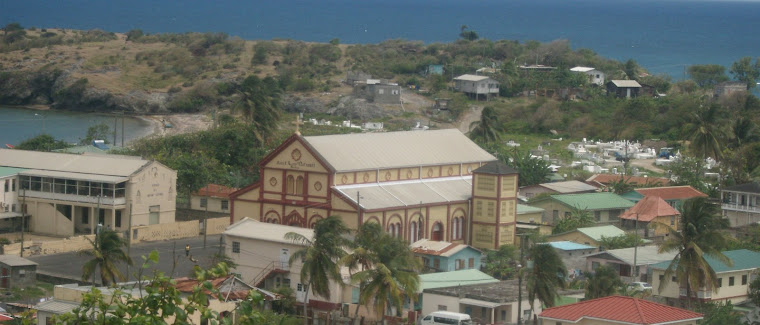
I live in a village and work in unstructured ways. This suits my work style well. Although English is technically the second language on the island, almost everyone speaks the language. I don’t have to learn another language to survive. I have electricity, running water, even hot water. Well, most of the times I have running water.

My son, Jay, was in Honduras. He lived in a remote village. He had no electricity or in-door plumbing. His floors were dirt. He taught sustainable farming methods such as terraced techniques and diversification. He can now read, write and speak Spanish fluently.

I have a friend, although I confess I have never met her in person, who is living in Romania. She is teaching in a climate where it gets extremely cold. She speaks Romanian. At times she can be seen riding on a donkey cart.

I have another friend, again one I’ve never met, who lived in Samoa. He lived in a rural village and, among other projects, focused on helping people with weight control and to learn about good nutrition.

Although each of us will have a different experience, there is one commonality I hear from almost all Peace Corps Volunteers. The pace is slower and it feels like time moves at a snails pace. The clock ticks but never tocks. There is simply more time.

The thing I’ve noticed is that I spend my extra time examining details. If someone asked me, “Are there any benefits of being a Peace Corps Volunteer besides the obvious?” I would unequivocally say, “Yes, I have time to reflect on moments rather than days or weeks”.


Thursday, March 25, 2010

Teaching

The Peace Corps has three goals. The first is to help people in another country, the second is to promote a better understanding of Americans and the third goal is to promote a better understanding of other peoples on the part of Americans.

Teaching is a way to check off each goal in a clean sweep. I gained something valuable from the Peace Corps experience: I have become more aware of the United States focus on business education. My experience is that more often than not, courses are taught in narrowly focused specific subjects rather than focusing the subject matter in a global perspective with a systems view.

Although there is usually a chapter in a text about the global environment, international courses are more often separate subjects when they should be integrated. There may be an inference to globalization, but no real information or exercises to help students learn what that really means. There are specific internationally focused degrees, but why? If we are to compete in a global environment, we can't think in global silos, but many times we teach students to think in silos. It's arrogant.

When I was teaching a course in Management Strategy, the text had a section on generational values. When we talked about this subject in class, the students were trying to bucket themselves in the American generational values. There was no qualification that the material is only relevant to one area of the world. I was stymied.

Although Saint Lucia is a westernized nation and some of the values fit, they have their own history which created their unique culture and generational values. The next few weeks I had them research and put their own generations into buckets.


For the first time, they began to think about the diversity they would face if they were to work in an American company. And, they began to recognize how their own value system can collide in the workplace here on this island. That exercise taught me as much about Saint Lucia as it taught them about American values. It was rewarding.

I teach Junior Achievement in the primary schools and none of the material is geared towards a global environment, although they have many customers in many countries. They have an exercise in making paper donuts when many children don't know what a donut is. They have stickers with American currency when children here only know the Eastern Caribbean Dollar. There is an exercise to elect a mayor, one of which supports a facility to take care of stray pets; neither of these things makes sense to the children in my village. It’s baffling.

The opportunities I have had to teach in a foreign country have helped me grow. I hope the tools I have passed on to them will help them in the years to come. I know the knowledge, culture, information and rich interaction they have shared with me will impact me for years to come.

When I think of teaching and how it connects with the goals of Peace Corps, I think I can easily check all three boxes.

Saturday, March 20, 2010

Frustrating Meetings

I have attended several meetings for this organization in the past. Leadership was poor and the meetings were increasingly frustrating. As a result, nothing was getting done and I realized this wasn’t the best use of my time.


I was surprised when I sat down at a recent meeting with this organization. There was enthusiasm. People were volunteering to do things to move forward and ideas were flowing. Then, I looked around and noticed the leader was not present.


There was a mix up in communicating the meeting. Many members weren’t there because the communication process didn't work. The consensus was to send out a new meeting notice for the following week and resume the rich conversation they had started that evening. It was all very exciting and hopeful.


At their insistence, I attended the meeting the following week. When I walked into the room, the leader was there. The focus of the meeting turned to members who have wronged the leader who was not invited to the last meeting. The momentum and any hope of progress came to a screaming halt.

Then, much like an archeological dig, the complaints went further and further. Each shovel of dirt uncovered another tidbit of wrong-doing. And with each shovel, I could see the members sinking further into the abyss of powerlessness and hopelessness.

By the end of the meeting, they were just sitting there being lectured to with no vision, no enthusiasm, no commitment, no participation and no volunteering to move forward. And worse, no leadership.


The meeting was pulled back into their circle of ineffectiveness and I was pulled back into the memory that this is the reason I stopped attending these meetings.

Monday, March 15, 2010

Jacks

I remember playing Jacks as a child. It was a matter of coordination. Sort of like rubbing your stomach and patting your head at the same time. The first time player usually finds it difficult, but once the rhythm is found, the game is easy.

It is an inexpensive game, easy to play; easy to transport. All I needed was a small rubber ball and a few jacks, a relatively cheap purchase at the local dime store. Dime stores, which sprang up in the late nineteenth century, slowly began disappearing in the 1960s.

My mom shopped at both Newberry’s and Woolworths, although Newberry’s was preferred. I went with her often, usually to buy patterns and cloth. She sewed many of our clothes and most of my doll clothes. The store had wood floors. When I close my eyes, I can hear the clomping of shoes and smell the scent of large bolts of material. I would wander through the store while my mother looked through huge books to choose a new Vogue Pattern.


I was usually allowed to buy some candy, a squirt gun or a small toy. I remember standing in line with my mother. She had thread, material and patterns in her hand. I had a small package of Jacks. Newberry’s and Woolworths both quietly gave way to the next generation; the discount store, Akron and Gemco which yielded to Walmart and Target.

Did you ever wonder about the origins of the game jacks? Neither did I. Well, that is until I saw a group of children in my village sitting on the ground with a pile of rocks. According to various sources on the internet Jacks is one of those games that children invented during ancient times and long before commercial toys were available. Rocks and bone fragments were used to play the game.

And, to think I’ve lived this long not knowing this little piece of trivia.

Thursday, March 11, 2010

Cabaway

Cabaway is the name, but likely I’ve misspelled the word. I’ve asked some people how it’s spelled and they stare at me with a puzzled look and then shrug. No one seems to know how it’s spelled.


I’m not sure if Cabaway is capitalized, but for the purpose of this post, capitalization is the rule.


I’ve looked up various was to spell it: cobeweit, kobeyweit, kob’weit, kobwuey. But each search turns up the same message, “Your search - kobwuey - did not match any documents.”


I ask people in my village more questions. When was the first Cabaway built? The most common answer is sometime after emancipation or maybe during slavery. If I knew how to spell it perhaps I could figure that out. But I don’t. Where did Cabaway’s originate? Was it Saint Lucia or perhaps a neighboring island? So many questions.


There is a Folk Research Center in Castries. They may be able to help. Maybe when I get extra time I will call and inquire. But does it really matter?


These are frustrating little questions in life. They are like little drippy faucets, hanging around just waiting for the moment when their lingering frustration creates a breaking point. But, let’s not dwell on it. I don’t need these pesky questions to occupy the only tiny spaces left in my brain that are still able to absorb some small piece of trivial information.


The Cabaway Boys don’t care. They are having fun pushing their homemade Cabaways down the street. They come in various sizes and styles. I’ve seen some large enough to carry a load of coconuts, although this is not its purpose. Or is it? Maybe it was originally a work tool, but then later morphed into a toy. It is a toy – right? Oh, these pesky unanswered questions!